
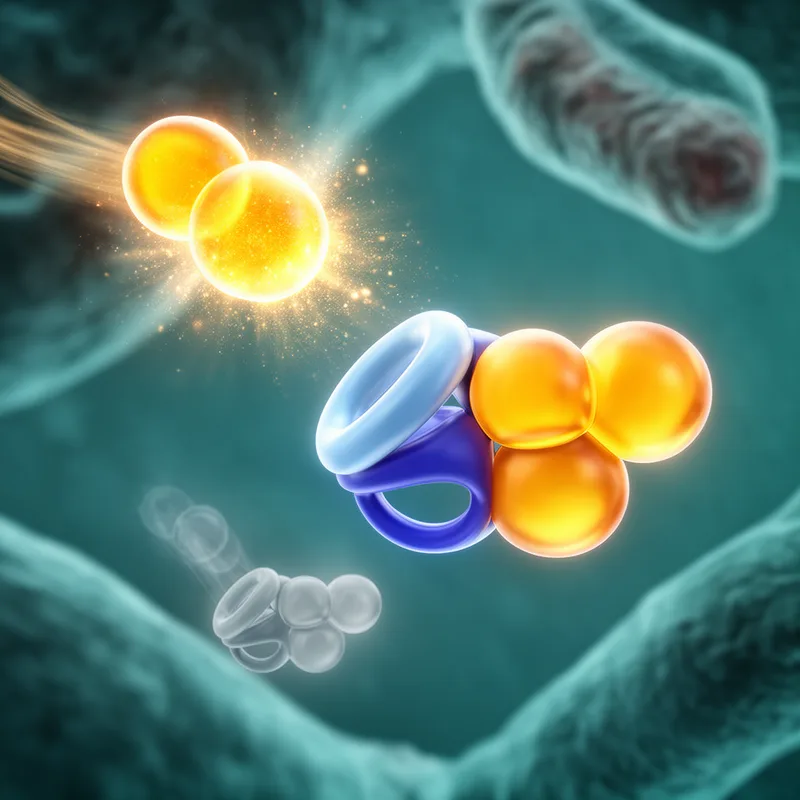
ADP
 1
6.8
1
6.8

- noun
- /ˌeɪ.diːˈpiː/
- Specialized
- Mitochondria are producing ATP, but they also play a role in how much ADP and AMP are in the cell.
- ADP-induced platelet
- ADP-induced
Loading YouTube…
Watch on YouTubeCreatine can donate its phosphate to ADP, reform ATP.
- Creatine can donate its phosphate to ADP, reform ATP.
- ATP and ADP are dramatically potent vasodilators.
- We know the levels of ATP to ADP or AMP also play a role, and mitochondria are doing those things.
- We take adenosine diphosphate, ADP and we add a phosphorus to it to make it ATP, and then we run all of our
Examples
-
The reaction cycle is completed with the release of the hydrolysis product, adenosine diphosphate (ADP).
Academic text (2006) -
Then 3 L of 30 mol/L ADP was added to the mixture to induce platelet aggregation.
Academic text (2014) -
And then you're stuck here until the ADP comes off.
-
And this happens for the ADP bound form and it facilitates ADP release, OK.
-
So they're all of these favourable large, largely positive and negative charge interactions that are holding the ADP in just the right place.
-
We know the levels of ATP to ADP or AMP also play a role, and mitochondria are doing those things.
-
Creatine can donate its phosphate to ADP, reform ATP.
-
Adenosine diphosphate (ADP) with a purity over 98% was purchased from Sigma (USA).
Academic text (2014) -
The reaction cycle is completed with the release of the hydrolysis product, adenosine diphosphate (ADP), which plays a crucial role in cellular energy transfer.
-
In cellular respiration, adenosine diphosphate (ADP) is converted to adenosine triphosphate (ATP) to store energy for various biochemical processes.
Synonyms
A small molecule with two phosphate groups that cells use to store and release energy
Compounds

- Specialized
A set of computers and programs that automatically store and manage employee data
Surface Forms
Morphology
ADP = A + D + P
ADP is an initialism (letters standing for adenosine diphosphate) rather than a morphological combination of English morphemes, so the letters do not transparently convey the meaning to learners.
Etymology
ADP is short for adenosine diphosphate, where the di- part means 'two', so it has two phosphate groups. In cells, ADP can gain one more phosphate to become ATP, which stores energy, so ADP is like a partly charged battery the cell can 'recharge' to get energy.