

yang
 37
8.9

- noun
- /jɑŋ/
- In Chinese culture, yin and yang have never been associated with moral values.
- yin and yang
- yang (masculine)
- the yang principle
Loading YouTube…
Watch on YouTubeThis is what means yin and Yang cannot be separated.
- This is what means yin and Yang cannot be separated.
- There's both yin and Yang in it coming together.
- You know, we, we are your typical yin and Yang.
- And so you guys get the principle of yin and Yang.
- It's kind of like both sides are like yin and Yang, the chaos and the good and the good and the chaos.
- Yeah, I, I appreciate that and and I'm glad that that stuck out because I, I view it as like a yin and a Yang shape that these two.
- It's a Chinese and I fucked that yin Yang Yin Yang Hua.
- He said I do this yin and Yang, good and evil.
- It's like a little yin and Yang packaging That's cute.
- But I was curious with your yin Yang styles, what's your favorite thing about each other?
- And yeah, he's the end of my Yang in that way.
Examples
-
They were the yin and yang to each other.
-
Yin and Yang are sort of like the light and dark sides of a mountain.
Academic text (2001) -
So, Charles, this thing about yin and Yang and comment on that.
-
I'm clearly the yin to your yang.
-
Interestingly, too much is a Yang thing, so too much Yang leads to Yin.
Blog text (19) -
Traditionally, the aggressive third chakra is considered a yang, or masculine, phase of life.
Academic text (1994) -
Dialectics is not foreign to the Chinese people; the Yin-Yang principles and five elements are the most salient examples.
Academic text (1996) -
In view of this patriarchal bias, the frequent association of yin with passivity and yang with activity is particularly dangerous.
Academic text (1993) -
And in a way, if you can trace it, the relationship between Bale and Crowe in this film has this kind of yin and yang, in and out...
-
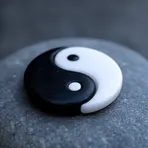
In Chinese philosophy, yang represents the bright, active force that balances the passive, dark energy of yin.
Antonyms
Idioms

Compounds

Surface Forms
Etymology
Yang comes from the Chinese word 陽, which once meant the 'sunny side' of a hill. That's why yang now means bright, active, and 'masculine' energy, the opposite of yin.