

xylene
 3
9.9
3
9.9

- noun
- /ˈzaɪliːn/
- Specialized
- Immunofluorescent (IF) staining of tissue was performed as previously described after tissue deparaffinization by clearance in xylene and hydration through a graded ethanol series.
Examples
-
The acetone, xylene
Fiction book (1990) -
Tao says his devices have proven sufficiently sensitive to detect benzene, toluene, ethylene, and xylene at concentrations of 1 ppb, comparable to commercially available detectors.
Academic text (2012) -
Finally, in pure xylene and placed overnight at room temperature.
Academic text (2014) -
You can also use like toluene or xylene or any of those other crazy not good for you chemicals.
-
Clearing of tissue was done in ethanol-xylene series.
Academic text (2014) -
Tissue sections were counterstained using hematoxylin and mounted in xylene.
Academic text (2017) -
Examples of VOMs include industrial chemicals such as benzene, perchloroethylene, toluene, and xylene.
Academic text (2007) -
Briefly, paraffin sections were de-paraffinized with xylene and rehydrated in a graded series of ethanol.
Academic text (2015) -
IHC staining was performed after tissue deparaffinization by clearance in xylene and hydration through a graded ethanol series.
Academic text (2017) -
Xylene is commonly used as a solvent in the printing industry because of its effectiveness.
Synonyms

 1
8.6
1
8.6
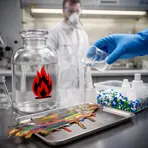
A colorless, flammable chemical called xylene that people use to dissolve other things and to make plastics

A clear liquid that burns easily and dissolves paint
Surface Forms
Morphology
xylene = xyl + ene
Although the form is built from the combining form 'xyl-' and the chemical suffix '-ene', the result is a technical chemical name whose meaning ('a specific solvent hydrocarbon') is not derivable by an average B1 learner from those parts.
Etymology
Xylene comes from the old Greek word xylon meaning 'wood', because chemists first found it in wood tar. The root xyl- also appears in xylophone, so to remember xylene think 'wood' and the oily liquids taken from it that became this solvent.