

worship of heavenly bodies
- noun
- The worship of heavenly bodies was common in many early cultures, reflecting awe of the night sky.
Examples
-
Ancient civilizations often engaged in worship of heavenly bodies as part of their religious practices.
-
Scholars study how the worship of heavenly bodies influenced art and architecture in history.
-
The worship of heavenly bodies can be seen in ancient texts.
-
Many cultures have a worship of heavenly bodies in their traditions.
-
Ancient civilizations often engaged in worship of heavenly bodies as part of their religious practices.
-
The worship of heavenly bodies was common in many early cultures, reflecting their reverence for the cosmos.
-
Scholars study how the worship of heavenly bodies influenced art and architecture in ancient societies.
Synonyms
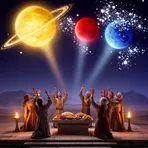
Worship of planets or stars as gods
Surface Forms
Morphology
worship + of + heavenly + body
The phrase is compositionally built: 'worship of' indicates reverence toward the following noun phrase, and 'heavenly bodies' transparently refers to celestial objects (stars, planets). A B1 learner who knows these words and the 'worship of X' pattern would readily infer the meaning; the same construction exists in many languages, supporting cross-linguistic transparency.
Etymology
The phrase worship of heavenly bodies comes from the simple image of people giving gifts and prayers to the bright heavenly bodies like the sun, moon and stars, which was their worship. So today the phrase means the practice of worshipping those 'planets or stars'.

