
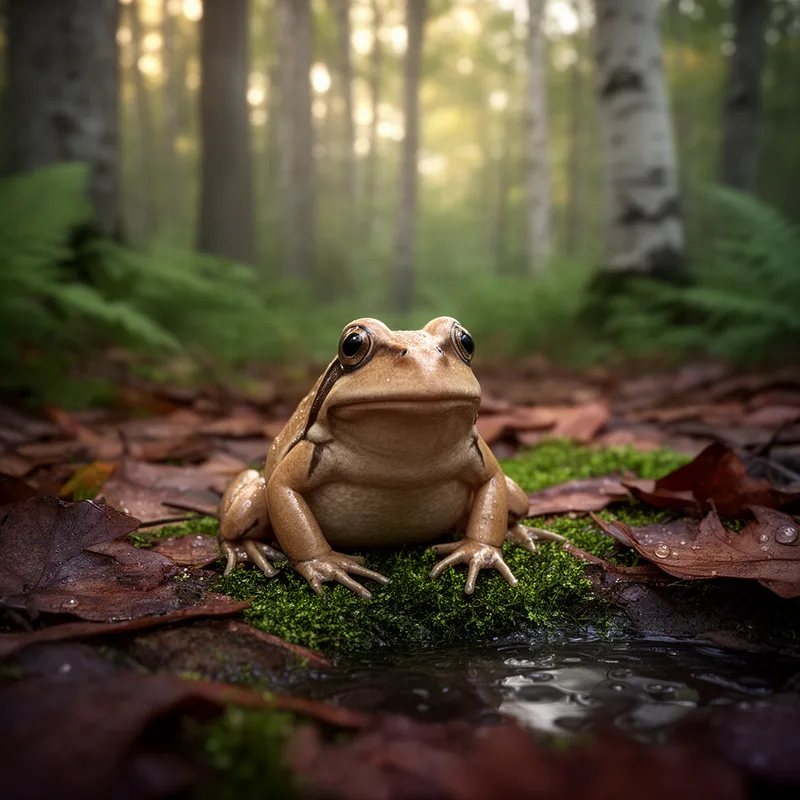
wood frog


 1
5.9
1
5.9
- noun
- /wʊd frɔg/
- US
- Under the assumption that changes in egg mass counts provide a valid index to changes in wood frog populations, these data can be used to guide the design of a regional wood frog monitoring program.
- wood frog (Rana sylvatica)
Examples
-
Under the assumption that changes in egg mass counts provide a valid index to changes in wood frog populations, these data can be used to guide the design of a regional wood frog monitoring program.
Academic text (1998) -
The wood frog can often be found hiding among the leaves in a moist woodland area.
-
For example, habitat use and juvenile survival for wood frogs were positive in the partial harvest relative to control treatments.
Academic text (2009) -
The wood frog (Rana sylvatica), a common pool-breeding and forest-dwelling frog of North America, provides a sample application of the power analysis approach described in this article.
Academic text (1998) -
Berven (1990) counted egg masses in vernal pools used by several breeding populations of wood frogs over a 6-year period in Maryland.
Academic text (1998) -
Species used for experimental studies included the spotted salamander, American toad (Bufo americanus), gray treefrog (Hyla versicolor), and wood frog.
Academic text (2009) -
In the spring, wood frogs emerge from hibernation to breed in temporary pools of water.
-
The wood frog's ability to survive freezing temperatures makes it unique among amphibians.
Synonyms

A small brown frog that lives in cold North American woods and can survive freezing
Surface Forms
Morphology
The meaning ('a frog that lives in wooded areas') is directly and compositionally derivable from 'wood' (wooded area) + 'frog' (amphibian). This noun–noun compound follows a common, cross-linguistic pattern indicating habitat or type, so a B1 learner who knows both constituents should readily infer the meaning.
Etymology
Wood frog is named for a simple picture: wood means 'woods' or forest and frog is the animal, so it literally means a frog of the woods. That's why the name refers to a small, light-brown frog that lives among leaves and trees in wet woodlands.