
womanist


 1
8.1
1
8.1
- adjective
- /ˈwʊmənɪst/
- Formal
- In her writing and research, Townes focuses on Christian and womanist ethics as well as cultural and social theory.
- womanist consciousness
- womanist and feminist
Examples
-
The second speaker in the 2012-2013 series, Townes is a professor, author, ordained minister, and womanist ethicist.
Blog text (21) -
While none of the classic motifs escape, the sharpest feminist and womanist critique falls on satisfaction atonement.
Academic text (2001) -
Her most recent book is "Womanist Ethics and the Cultural Production of Evil."
Blog text (21) -
Haynes can be described as a "race woman" with a womanist consciousness.
Academic text (1997) -
"Lots of small pieces" is a fitting phrase to describe Haynes's "womanist race work."
Academic text (1997) -
However, womanist critiques of feminist theology challenged the veracity of Ruether's claim.
Academic text (1998) -
This article discusses implications for social work practice based on Haynes's womanist consciousness, her commitment to social work on behalf of her race, and her activist community involvement.
Academic text (1997) -
The scale measures attitudes toward women and includes items that assess conservative beliefs about women as well as five distinct feminist perspectives: liberal, radical, socialist, cultural, and womanist feminisms.
Academic text (2006) -
These observations about the implied role of God the Father in satisfaction and moral atonement motifs help explain why a number of feminist and womanist writers have claimed that atonement theology presents an image of divine child abuse.
Academic text (2001) -
Many scholars consider her approach to be distinctly womanist as it highlights the unique experiences of Black women.
Surface Forms
Morphology
Etymology
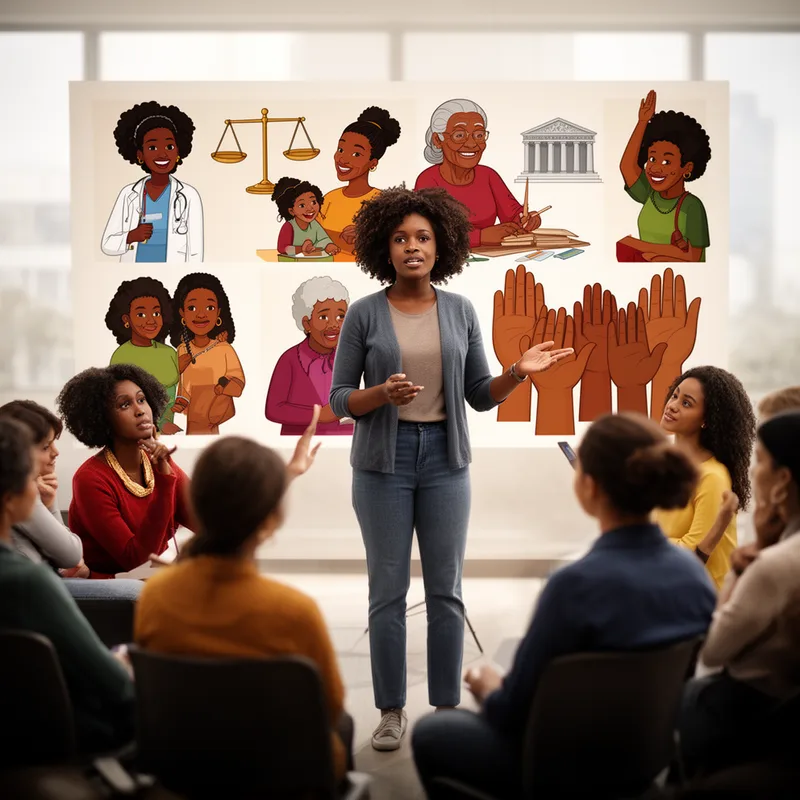
Womanist comes from woman and the ending -ist meaning 'one who', and was made popular by the writer Alice Walker in the 1980s when she used it for a movement that focuses on Black women's lives. So, a womanist view is about those ideas and the rights and experiences of Black women.