
windowing
- noun
- /ˈwɪndoʊɪŋ/
- Specialized
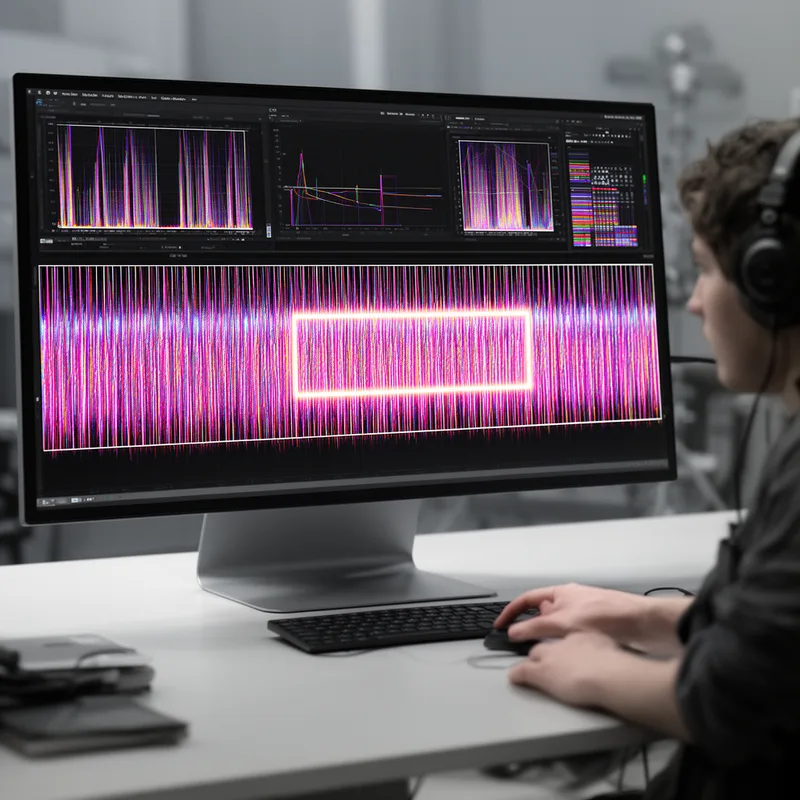
- And so it turns out this process of windowing a piece of data with this square pulse actually does really horrible things to our spectral estimate.
Examples
-
Note that this approach is unlike that of conventional time-series signal analysis, where windowing techniques are applied to fit a signal to the fixed window length of the FFT.
Academic text (2011) -
The first stage, signal pre-processing, consists of the conditioning and windowing of the accelerometer samples.
Academic text (2016) -
Then we're going to average that spectrum together for for all the different windowing tapering function.
-
All sensor types support windowing to allow high-speed readout of subarrays.
Academic text (2003) -
However, it is likely that such innovations as hypertext and windowing (which permits easy movement from one program to another) will enable more vendors to incorporate word-processing strategies into their test generators within the next few years.
Academic text (1993) -
The windowing process helps in accurately analyzing the frequency components of the signal.
-
During the experiment, scientists employed windowing techniques to segment the data for better clarity.
-
Effective windowing of the time series allows for more precise statistical analysis of the variable.
Synonyms

 3
6.1
3
6.1

Dividing something into separate parts
 3
6.0
3
6.0
Dividing something into parts or groups
Surface Forms
Morphology
windowing = window (semi-transparent) = window + ing
Morphologically transparent as 'window' + '-ing', but the signal-processing sense is technical and may not be predictable for an average B1 learner.
Etymology
Windowing comes from the word window, meaning 'an opening' or a small view. In data and signal work, windowing means cutting the data into small parts or 'windows' so each piece can be looked at or processed. So, windowing lets engineers focus on one small part at a time to reduce noise and find patterns.