
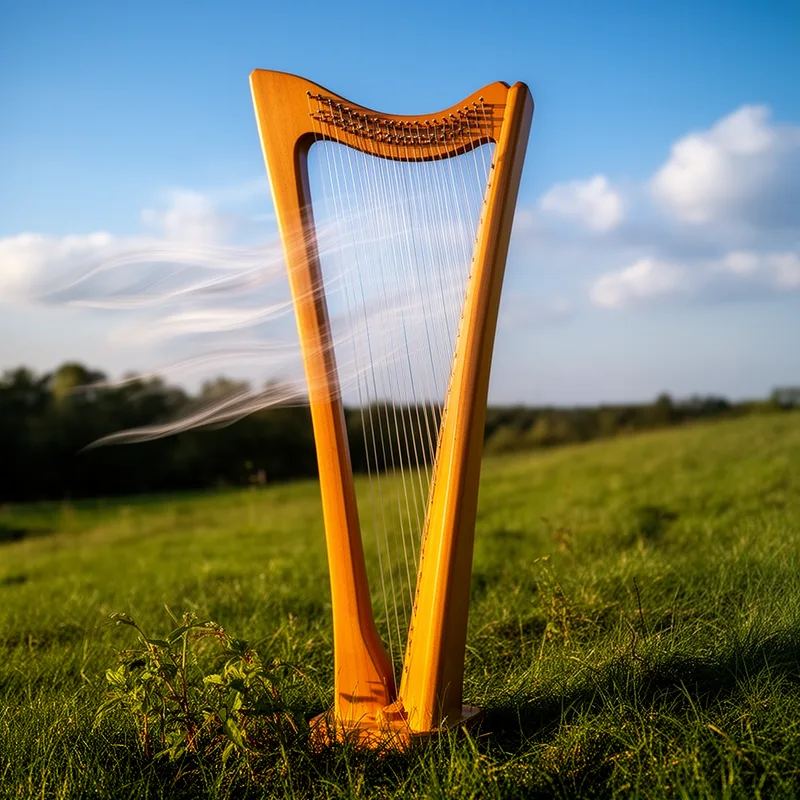
wind harp
- noun
- /wɪnd hɑrp/
- In the garden, the artist installed a wind harp that played soothing music as the breeze passed.
Examples
-
Sounds a bit like a wind harp.
Blog text (12) -
As we walked along the beach, we could hear the gentle notes of the wind harp blending with the sound of the waves.
-
The wind blew softly through the strings of the wind harp, creating beautiful melodies.
Synonyms

 37
1.9
37
1.9

A large stringed instrument with a triangular frame that you play by plucking
 4
2.9
4
2.9
A musical instrument that makes sound when its strings are played, like a guitar or violin

An instrument with strings that the wind plays to make soft music

A string instrument like a small harp that the wind plays to make music
A musical instrument that makes sound by vibrating strings, like a violin or harp
Surface Forms
Morphology
The meaning is directly derived from the constituents: a harp (stringed instrument) that is sounded by the wind, so the sense is literal rather than idiomatic. This descriptive compound follows common cross-linguistic patterns for naming instruments (e.g., Aeolian/wind harp), making it immediately understandable to a B1 learner who knows both words.
Etymology
Wind harp names an instrument where the wind moves the strings of a harp like a player's fingers, so the instrument makes soft 'music' without a person. That's why the name links wind and 'harp' and it means an object that plays when the breeze blows.