

wild thyme


 1
6.1
1
6.1
- noun
- /waɪld taɪm/
- UK
- We found a patch of wild thyme growing on the hillside during our hike.
- wild thyme and oregano
Examples
-
In spring, the wild thyme blooms with small purple flowers on the sunny banks.
-
But, I know where the wild thyme blows.
-
MILES, "where the wild thyme grows."
-
She tastes of wild thyme, strawberries, mystery.
Fiction book (1993) -
In the forest along the pathways, the wild thyme, lavender, and pines were just so aromatic.
Blog text (31) -
It smells of wild thyme, hemlock, and mysteries.
Fiction book (1993) -
The smell of sewage they used to water the abundant gardens mingled with the parched smells of wild thyme and sage from the hills.
Fiction book (1997) -
Those broken stems of wild thyme I still found tangled in your hair that night in our room—the wide splotches of shade from the fig leaves on the ground around us, your breath against my neck.
Fiction book (1994) -
The aroma of wild thyme filled the air as we walked through the garden.
Synonyms
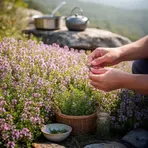
A low, spreading plant with a strong smell used to cover ground and for cooking or medicine

A low, spreading plant with small purple flowers and a pleasant smell used as ground cover

A low, fragrant plant with small purple and white flowers that grows close to the ground
Surface Forms
Morphology
The phrase is a straightforward adjective + noun composition: 'wild' (growing naturally) modifying 'thyme' (the herb), so its meaning 'thyme growing in the wild' is directly derivable from the constituents. This is a common, cross-linguistic compositional pattern, so a B1 learner who knows both words will understand the MWE.
Etymology
Wild thyme is named for the simple picture of small thyme plants growing wild on sunny hills and banks instead of in gardens. These tiny plants have many small purple flowers and a strong smell that attracts bees, so the name helps you remember it is the natural herb people pick for cooking and for its scent.