
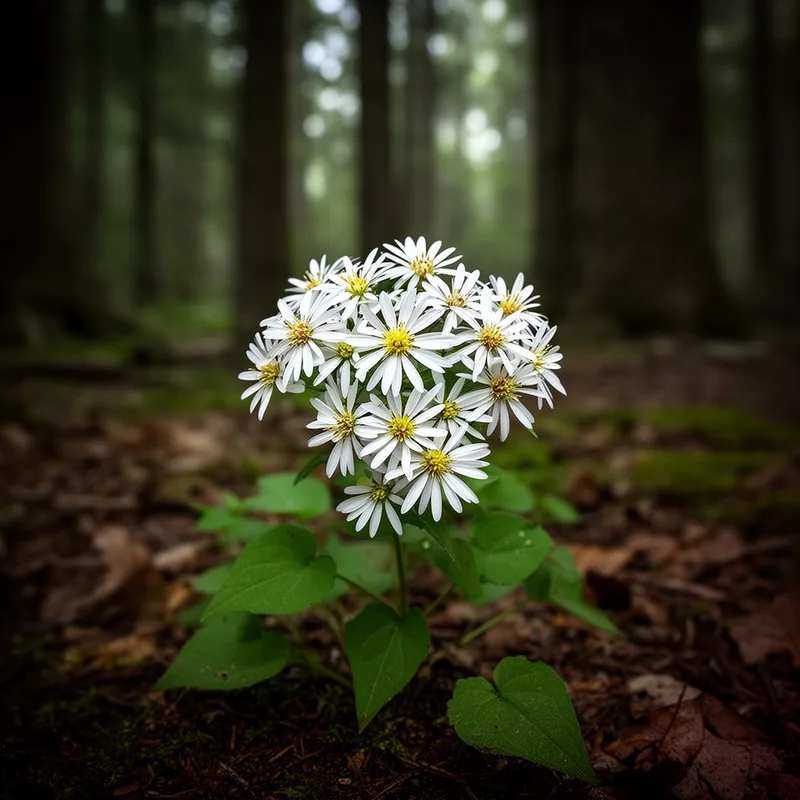
white wood aster
- noun
- /waɪt wʊd ˈæstər/
- US
- The white wood aster blooms in shaded forests from late summer into autumn.
Examples
-
Gardeners value the white wood aster for its delicate white flowers and hardy nature.
-
I saw a beautiful white wood aster in the forest.
-
You can recognize a white wood aster by its star-shaped petals and heart-shaped leaves.
-
The white wood aster blooms in late summer.
-
In the forest, the white wood aster brings a burst of white flowers that brighten the shaded areas in late summer.
-
The white wood aster can often be found thriving in rich, moist soil under the canopy of tall trees.
-
During a hike in the woods, I spotted beautiful clusters of white wood aster blooming among the ferns.
Synonyms

A plant that lives many years, grows in woods, has white flowers, and spreads by underground stems
Surface Forms
Morphology
The phrase is fully compositional: 'aster' names a type of flower, modified by 'white' (color) and 'wood' (indicating woodland habitat), so the sense 'a white aster that grows in woods' is directly derivable from the constituents. This is a straightforward plant-naming pattern found across languages and involves no idiomatic or metaphorical shift, so learners who know the component words will understand it.
Etymology
The name white wood aster simply describes the plant: white for its pale flowers, wood because it grows in shaded forests, and aster from a word for 'star' that points to its star-shaped petals. So the name gives a quick picture to help you remember the plant.

