
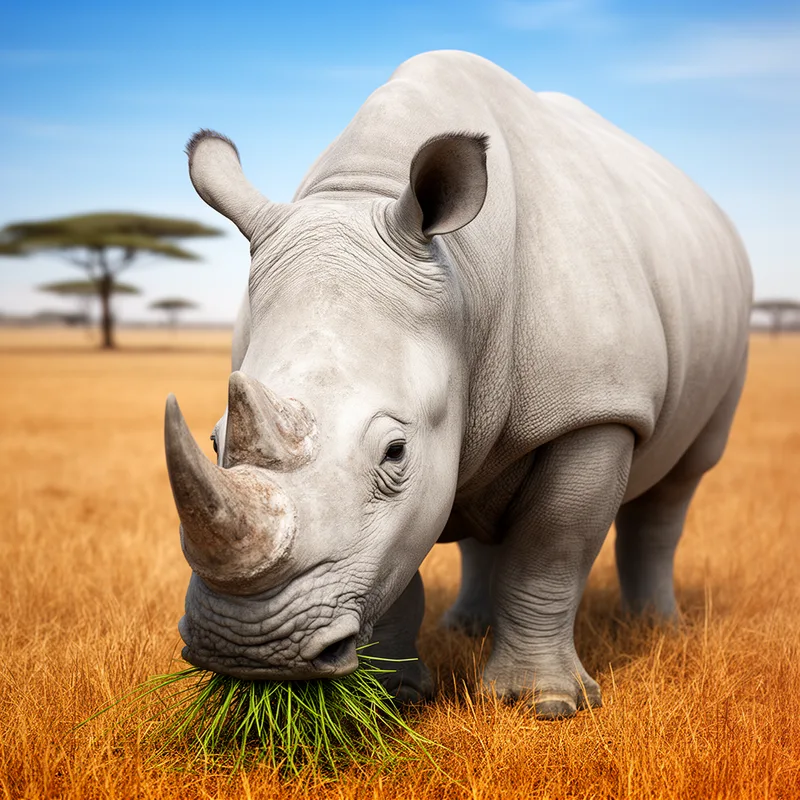
white rhinoceros
- noun
- /waɪt raɪˈnɒsərəs/
- South African
- Its collection comprises approximately 450 animals ranging from pygmy marmosets to white rhinoceroses.
- northern white rhinoceros
Examples
-
But consider the white rhinoceros, the second-largest land animal, which can weigh more than 5,000 pounds.
Academic text (2007) -
The mounted head of a white rhinoceros, two glass eyes shining under hard grey lids.
Fiction book (1999) -
The white rhinoceros, the world's second-largest land mammal, has two subspecies, one of which lives in southern Africa and now numbers more than 11,000.
Academic text (2006) -
Pink hot-fly larvae in an intermediate, or second instar, stage of growth, feed on the stomach wall of a white rhinoceros that has just died (left).
Academic text (2006) -
There were three albums devoted to botany and three devoted to those animals on which the expedition specially focused: the okapi, the giant eland, and the white rhinoceros.
Academic text (1991) -
The white rhinoceros is known for its impressive size and can weigh over 5,000 pounds.
-
Conservation efforts are critical to prevent the extinction of the white rhinoceros in Africa.
-
Visitors at the wildlife park were excited to see the white rhinoceros roaming freely in its natural habitat.
Synonyms
A very large light grey African rhinoceros with two horns that is endangered in the wild
A large light grey African rhino with two horns that is now endangered
Surface Forms
Morphology
The phrase composes an adjective + noun in a standard, productive way: a B1 learner who knows 'white' and 'rhinoceros' will naturally infer a rhinoceros characterized by whiteness (i.e. a species/name for a rhino). Although the taxonomic name historically comes from Afrikaans and the animal is actually light‑grey rather than pure white, this naming quirk does not prevent learners from deriving a sensible meaning from the constituents.
Etymology
White rhinoceros may come from the Dutch word 'wijd' meaning 'wide', because this rhino has a very wide, square mouth for grazing. English speakers heard 'wijd' as white, so the name stuck, but it really refers to the large light-grey African rhino with two horns.

