

whistling swan
- noun
- /ˈhwɪslɪŋ swɑn/
- Specialized
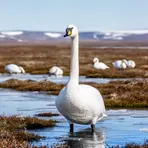
- Researchers observed a flock of whistling swans resting on the tundra near the lake.
Examples
-
The whistling swan is easily recognized by its soft, high-pitched call as it flies overhead.
-
The whistling swan glided gracefully across the lake.
-
Each spring, thousands of whistling swans migrate along the Pacific Flyway to their breeding grounds in Alaska.
-
We spotted a whistling swan during our nature hike.
-
The whistling swan is known for its distinctive, soft calls that echo across the lakes.
-
During the spring migration, we spotted a whistling swan gliding gracefully on the water.
-
The park is home to many birds, including the beautiful whistling swan, which attracts birdwatchers.
Synonyms


 1
7.4
1
7.4
A large white bird with a long neck that breeds in Arctic tundra

A North American swan that makes a soft whistling call

A medium-sized white swan that nests on Arctic tundra and flies far south for winter
Surface Forms
Morphology
The phrase is a straightforward adjectival noun phrase: 'whistling' describes a characteristic (making a whistling sound) of the 'swan', so the meaning is directly compositional. This is a common, cross-linguistic pattern (a noun modified by a participle) and a B1 learner who knows both words would readily infer it refers to a swan that makes a whistling call.
Etymology
Whistling swan is a name people gave to a type of swan that makes a soft, high 'whistle' when it flies, and early hunters and bird watchers used this sound to tell it apart from louder swans. So, the name links whistling (the sound) and swan (the bird), which explains why the phrase refers to that quiet, whistling bird.