
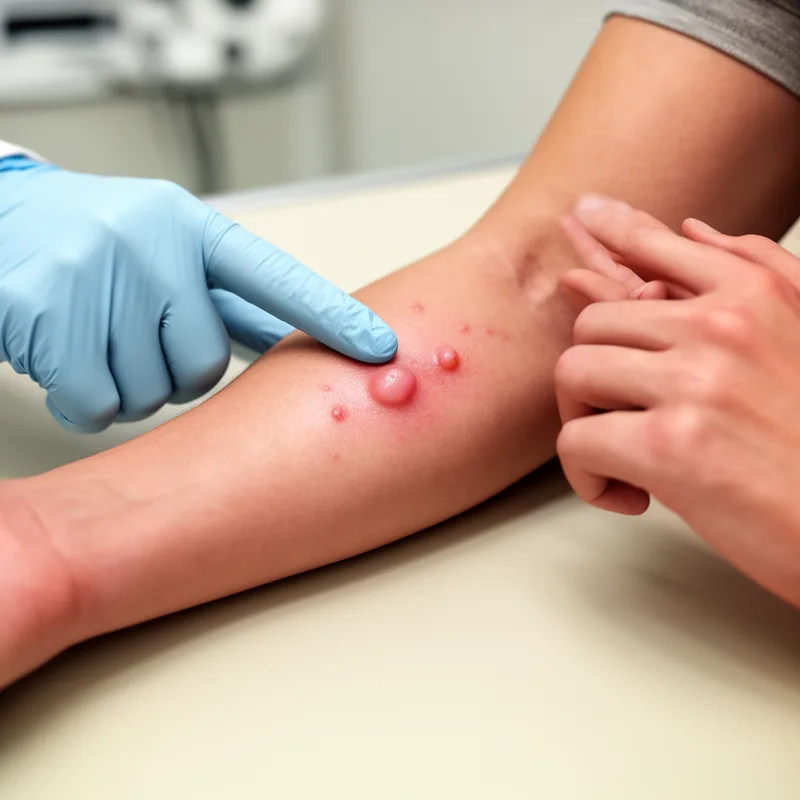
wheal


 1
9.0
1
9.0
- noun
- /wiːl/
- Specialized
- If the test is positive, a wheal will appear after about 20 minutes.
- wheal and flare
Examples
-
Individual scratch or intradermal tests were considered to be positive when either the wheal or flare was at least 5 mm larger than the negative diluent control.
Academic text (2003) -
Any positive result (wheal greater than 3 mm) placed that patient in the AR group.
Academic text (2008) -
Skin sensitivity was measured in millimeters of wheal and flare.
Academic text (2003) -
Urticaria is characterized by fluctuating wheals and/or angioedema. A wheal consists of three typical features:
Academic text (2012) -
Urticaria is characterized by fluctuating wheals and/or angioedema. A wheal consists of three typical features:
Academic text (2012) -
Intradermal injection of substance P causes wheals, redness, and itching, which may at least in part be due to histamine release from mast cells.
Academic text (1999) -
If the test is positive, a wheal will appear after about 20 minutes.
-
The raised area is called a wheal, and if the cat has been stung more than once, you will see several of these.
-
Her skin showed several wheals after she experienced an allergic reaction to the insect bites.
Synonyms
 17
6.5
17
6.5
A raised red mark on the skin caused by a hit, pressure, or an allergy
 1
9.9
1
9.9
A red swollen mark on the skin after being hit or bitten

A raised, red, swollen bump on the skin after a hit or sting

A raised red mark on the skin caused by a hit or an allergy
How Raised

Surface Forms
Etymology
Wheal comes from an old English word for a 'raised mark' on the skin, like a welt. A helpful way to remember it is to imagine a tiny 'wheel' or bump appearing after a sting, which is why a wheal is a small, itchy, raised patch on the skin.