

whale sucker
- noun
- /weɪl ˈsʌkər/
- The whale sucker uses its suction disc to cling to passing whales.
Examples
-
Biologists studied how the whale sucker benefits from riding on large marine mammals.
-
A group of whale suckers were seen attached to a dolphin during the marine research trip.
-
The whale sucker is often found swimming near large marine mammals.
-
Many whale suckers attach themselves to whales for transportation.
-
A group of whale suckers were seen attached to a dolphin during the marine research trip.
-
Biologists studied how the whale sucker benefits from riding on large marine mammals.
-
The whale sucker uses its suction disc to cling to passing whales.
Synonyms
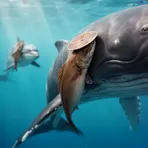
A large fish that has a flat disc on its head and sticks to whales and dolphins

A large blue fish that sticks to whales and dolphins
Surface Forms
Morphology
The noun is compositionally transparent: 'whale' identifies the host and 'sucker' denotes a suction organ/agent, so a learner who knows both words can infer this is an animal that attaches to whales by suction. This follows ordinary English compound-noun formation and is a cross-linguistically common way to name symbiotic/parasitic animals, making the meaning predictable for a B1 learner.
Etymology
The noun whale sucker comes from a clear picture: the word sucker shows how the fish 'sucks' onto a whale with a flat suction disc on its head, so the name now means a fish called a remora that clings to whales and dolphins.

