

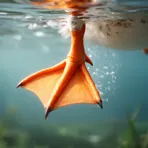
webbed foot
 2
3.0
2
3.0

- noun
- /ˈwɛbd fʊt/
- The penguin's webbed feet help it swim efficiently in the cold ocean.
- ducks have webbed feet
- big webbed feet
Loading YouTube…
Watch on YouTubeOr why does the dock have webbed feet, which causes Franklin to invent swimming flippers and causes Leonardo to try to understand flying.
- Or why does the dock have webbed feet, which causes Franklin to invent swimming flippers and causes Leonardo to try to understand flying.
Examples
-
I think now of the lyre-necked swans, imperial and calm, while their wide webbed feet shuttled furiously beneath the water line.
Fiction book (1997) -
Webbed feet, studded with curving claws, flapped across the smooth floor as the creature advanced.
Fiction book (1992) -
Then he looked down at his own webbed feet.
Fiction book (1998) -
The turtle has stringy legs and webbed feet.
Fiction book (2000) -
Then she dove, her webbed feet popping out of the water just briefly.
Fiction book (1992) -
The loon kicked its big webbed feet a few times in protest, but then quieted down.
Fiction book (2001) -
Propelled by their large webbed feet, the birds are powerful and swift underwater swimmers.
Academic text (2009) -
Before Alicia noticed, Trillhalla, with a flick of her webbed feet, propelled herself from the water into the canoe beside the visitors.
Fiction book (1992) -
The duck uses its webbed feet to paddle swiftly across the pond.
-
With her webbed feet, the otter glided effortlessly through the water.
Synonyms

 1
8.0
1
8.0
A foot with skin between the toes that helps animals like ducks or frogs swim
How Aquatic
10
3.1
 2
3.0
2
3.0
Surface Forms
Morphology
The meaning 'a foot with toes connected by a membrane' is directly and literally built from 'webbed' (toes linked by a membrane) + 'foot' (the body part). This descriptive, compositional compound follows common cross-linguistic patterns, so a B1 learner who knows both constituents will readily understand it.
Etymology
Webbed foot: The noun webbed foot names a foot whose toes are joined by thin skin, so the webbed part looks like a small web between the toes. That joined 'web' helps the animal push water, so a webbed foot is named for its ability to help it 'swim'.