
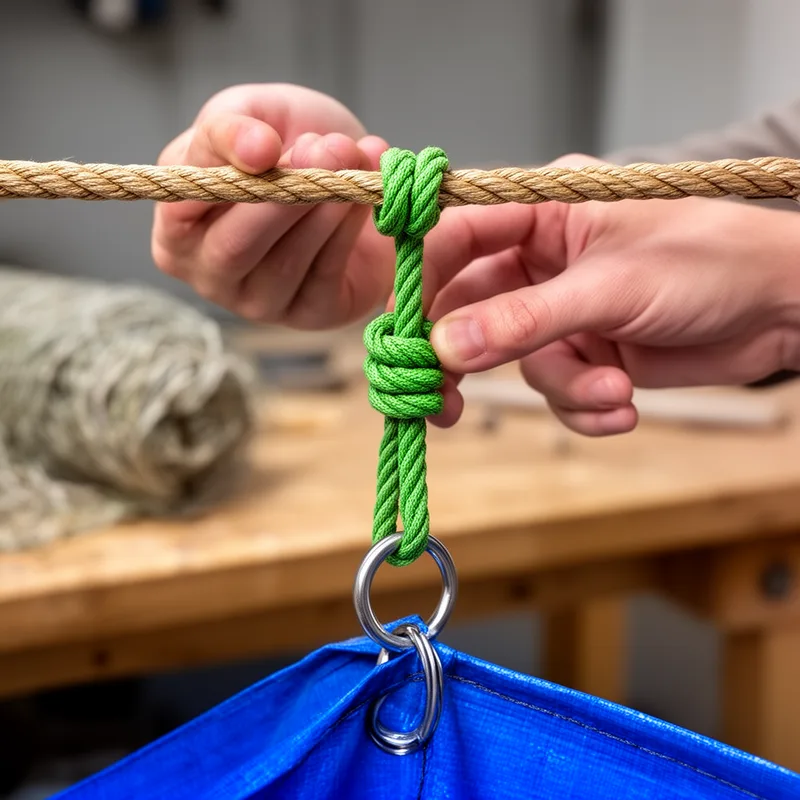
weaver's hitch
- noun
- Specialized
 :
nudo de tejedora
:
nudo de tejedora
- He secured the tarp to the rope using a weaver's hitch for easy removal.
Examples
-
The sailor demonstrated how to make a weaver's hitch.
-
The weaver's hitch is commonly used in net making and other crafts.
-
After practicing several times, she could tie a weaver's hitch without looking.
-
He tied a weaver's hitch to secure the load.
-
He secured the tarp to the rope using a weaver's hitch for easy removal.
-
After practicing several times, she could tie a weaver's hitch without looking.
-
The sailor demonstrated how to make a weaver's hitch on the dock.
Synonyms

 5
4.8
5
4.8

A quick knot that can be tied and untied


 1
8.4
1
8.4
A knot used to join one rope to another, even when they are different thicknesses

A knot that ties one rope to the middle of another rope or to a loop

To tie one rope or thread temporarily to the middle of another rope to join them
How Secure
- Specialized
4
8.2

- Specialized
- Specialized
- Specialized
1
8.5
- Specialized
1
6.5
3
5.5
Surface Forms
Morphology
weaver's + hitch
The headword combines a familiar noun 'hitch' (a temporarily tied knot) with a possessive modifier 'weaver's' indicating a particular variety or association. A B1 learner who knows both constituents can therefore infer this is a specific type of temporary knot associated with weavers (or named after a weaver), even if they cannot recreate the exact tying technique.
Etymology
Weaver's hitch may come from craft workers called weavers who needed a quick knot, a hitch, to fasten a rope to another rope while they made nets or cloth. Because it was easy to make and undo, the name now means a knot used to 'temporarily' tie a rope to the middle of another rope or to an eye.