
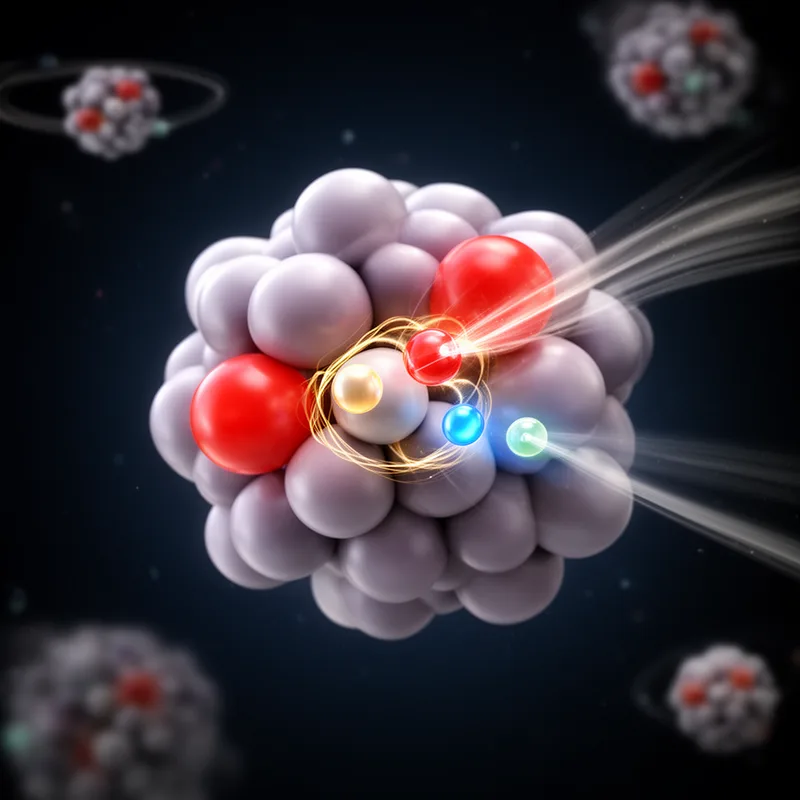
weak force
 2
8.3
2
8.3

- noun
- /wiːk fɔrs/
- Specialized
- Nowadays, it is well known that most of the phenomena in the Universe can be interpreted successfully using one or more of the following interactions: (1) gravity; (2) electromagnetism; (3) weak force; (4) strong force.
- electromagnetic and weak force
Loading YouTube…
Watch on YouTubeThe strong force has gluons, the weak force has W&Z; bosons.
- The strong force has gluons, the weak force has W&Z; bosons.
- Or whether or not, you know, some quarks feel the weak force and other quarks do not.
- So we have those four forces, a strong force, the weak force, the radiation force, the electromagnetic force and gravity.
Examples
-
Because its effective range is limited to distances of one one-thousandth the size of the proton, the weak force only rarely affects the motions of quarks—and it is never the agent that binds matter together.
Academic text (2006) -
There's a thing called the weak force, which causes radioactivity.
Fiction book (1999) -
Why is gravity such a weak force?
Blog text (20) -
When a nucleus disintegrates, it is usually the weak force at work.
Academic text (2006) -
The weak force plays a crucial role in the process of beta decay in atomic nuclei.
-
During radioactive decay, interactions occur via the weak force, influencing particle transformation.
-
In particle physics, the weak force is responsible for the decay of unstable particles into more stable forms.
Synonyms
 1
8.1
1
8.1
A basic force that makes some tiny particles change and causes some radioactive decay
Surface Forms
Morphology
The phrase is compositionally clear: 'weak' modifies 'force', so a learner who knows both words can infer it means a force that is weak. However, the term refers to a specific technical concept (the weak nuclear interaction responsible for certain particle decays) whose detailed meaning and implications are not predictable from the simple adjective+noun, making it only partially transparent to a B1 learner.
Etymology
Weak force comes from early studies of atoms, when scientists found this force was much smaller than the 'strong' force that holds the atom together. It acts only at very small distances and makes some tiny particles change or 'decay', so the name helps you remember it is the force that is 'weaker' than the others.