

wavenumber
- noun
- /ˈweɪvˌnʌmbər/
- Specialized
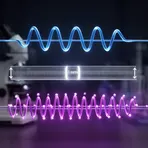
- In spectroscopy, the wavenumber indicates how many waves pass a point in a given distance, helping to identify chemical substances.
- wavenumber k
- higher wavenumbers
Examples
-
The resonance occurs at a wavenumber of about 30 cm<sup>-1</sup>, corresponding to a wavelength of 330 microns in the far infrared and a photon energy of 3.7 meV.
Academic text (1994) -
The results obtained by the Yorktown Heights group are consistent with the adatoms acting as quite hard spheres at low wavenumbers, but they seem to permit some transmission at higher wavenumbers.
Academic text (1993) -
Ulrich predicted that a specific pattern of wavenumber and frequency ought to be observed.
Academic text (1995) -
At higher wavenumbers, the steps become permeable.
Academic text (1993) -
Complexity can be thought of as the wavenumber diversity in a waveguide or scattering medium.
Academic text (2004) -
The latter determines the ratio of the energy flux toward higher wavenumber to the flux in the opposite sense.
Academic text (1995) -
In particular, at any selected bias, thermal effects cause one to probe a range of electron wavenumbers.
Academic text (1993) -
His group found that for electrons with low wavenumbers, a step acts like a hard barrier, so that the corresponding surface states on adjacent terraces are relatively isolated.
Academic text (1993) -
At low temperatures, the low-density photoholes populate mostly the states with small wavenumbers k much less than kF.
Academic text (1994) -
A large aperture, that is, a detector array filled with many elements, provides high resolution or focusing capability because of the wavenumber (or angle) spread that it can efficiently sample.
Academic text (2004)
Synonyms


 1
7.8
1
7.8
A count of repeating movements per metre of light or sound
Surface Forms
Morphology
Etymology
Wavenumber is just the parts wave and number, meaning the 'number of waves' in a distance. Think of counting how many sea waves fit along a rope — that picture explains why wavenumber tells you how many waves are in a certain distance and is useful when scientists study light and materials.