
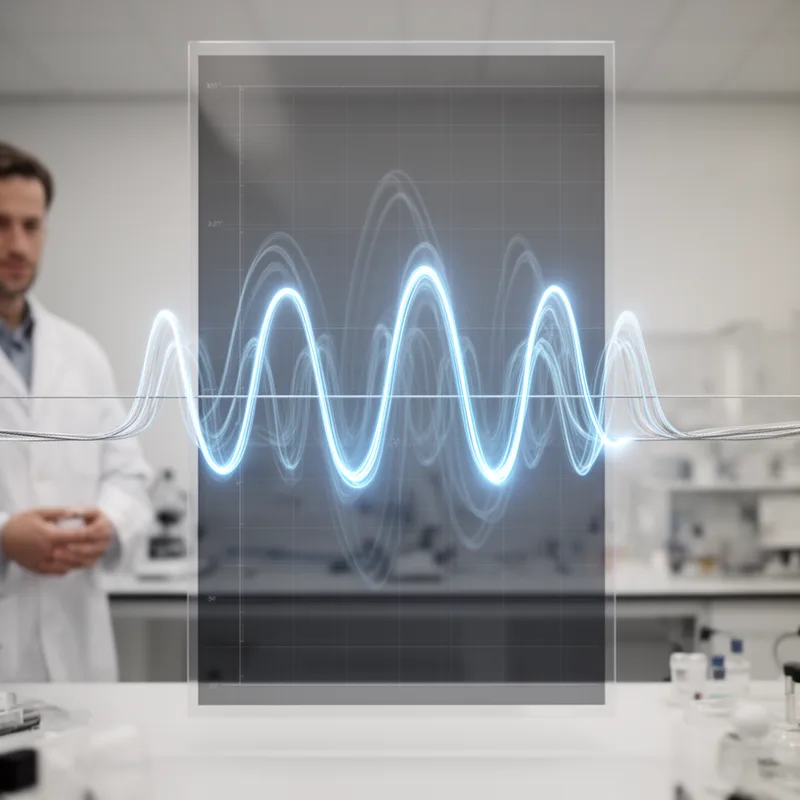
wave function
- noun
- /weɪv ˈfʌŋkʃən/
- Specialized
- Moving through broad smooth features doesn't disrupt the wave function and break it up into pieces.
Examples
-
But there we were just trying to get a reasonable form for a wave function of some particular energy, right?
-
That is, it's only toward the future that the wave function suddenly contracts.
-
You would say my wave function is more localized.
-
When we set up an experiment and we write down the wave function for it, then this wave function does not describe the actual real state of the system.
-
So this is not a possible wave function for either fermions or bosons.
-
In quantum physics, the wave function provides a mathematical description of the probability amplitude of a particle's position.
-
The scientist analyzed the wave function to understand the behavior of electrons in the system.
-
For each state of the system, there exists a unique wave function that describes its measurable properties.
Surface Forms
Morphology
The noun compound is compositionally interpretable — a B1 learner who knows 'wave' and 'function' can infer it is a function related to waves (i.e. a mathematical mapping describing wave behaviour). However, the precise sense as the formal quantum‑mechanical object that encodes a system's state is technical and requires domain knowledge, so the meaning is only partially predictable from the parts.
Etymology
Wave function comes from joining wave (a moving shape like on water) and function (a math rule). It is a math rule that shows how a wave moves or changes, so it means 'a formula that describes a wave'.

