

watermark
 3
4.4
3
4.4

- noun
- /ˈwɔːtərˌmɑrk/
- The paper had the watermark of a Continental soldier, musket in hand, pointing to the legend Pro Patria.
Loading YouTube…
Watch on YouTubeAn inch of white impressed like watermarks on cotton rag paper over the pen strokes of residual grass.
- An inch of white impressed like watermarks on cotton rag paper over the pen strokes of residual grass.
Examples
-
A watermark identical to the portrait is visible from both sides when held up to a light.
-
Watercolor paper sheets usually contain a watermark in one of the corners that can be viewed when held in front of a light source and tilted.
Academic text (2015) -
Someone else was holding a piece of paper with writing on it up to the light, possibly looking for a watermark.
Fiction book (1991) -
Cheap paper with no watermark.
-
I looked for the watermark in the stationery.
Academic text (1992) -
There was a little notebook tucked inside with a cute little elephant watermark on the pages.
Blog text (4) -
The strong, coarsely ribbed paper bears the watermark of a gothic 'p' with a flower, which between 1460 and c. 1530 was the most widespread mark in the Rhinelands, from the Upper to the Lower Rhine, in the Netherlands, and in Burgundy.
Academic text (1995) -
The cream-colored paper was heavy and stamped with a watermark.
-
You should be able to see a clear and distinct watermark portrait of Yusof Ishak on the left side of the note.
Synonyms
 22
4.2
22
4.2
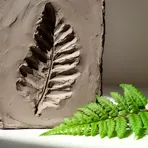
A mark made when something presses into a surface or the tool that makes it
Surface Forms
Morphology
Etymology
Watermark comes from old paper-making, where a pattern was pressed into wet pulp so it leaves a faint 'mark' you can see when you hold the page to the light. That's why banknotes and good paper have watermarks to show they are real.