
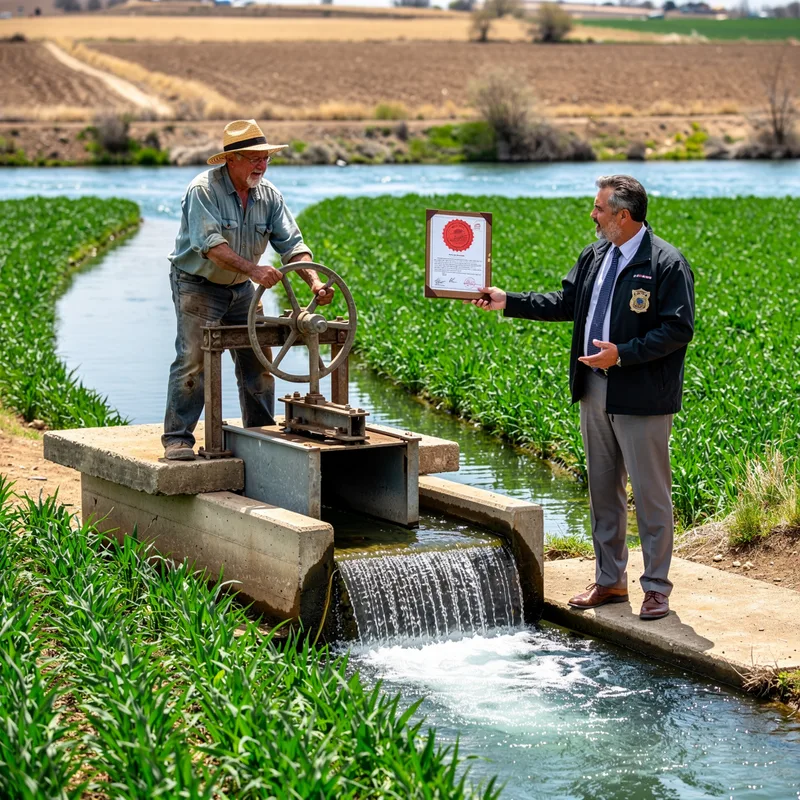
water right
 6
5.7
6
5.7

- noun
- /ˈwɔːtər raɪt/
- Specialized
- In 1973, Colorado passed an in-stream flow law to acquire water rights for fish and wildlife populations.
- local water rights
- Indian water rights
- collective water rights
Loading YouTube…
Watch on YouTubeSo it's not farming then water rights, right?
- So it's not farming then water rights, right?
- I mean, how can you buy a real estate property without making sure that the water rights are perfected?
- So this lawsuit, which is about water rights and native rights, has for me a very deep human component.
- We have been involved in almost every major piece of litigation involving water rights and the protection and preservation of tribal resources.
- So when we do our research, we check water rights, we check if there's anything still on the table of having a permit, and then can we re permit.
Examples
-
I authorize a 150-year lease on the property and water rights.
-
In most cases, the most senior water rights on western streams are used for irrigation agriculture.
Academic text (2008) -
In a sample local program, a group might examine water rights in California.
Academic text (1993) -
Collaboration, instead of competition, is the only way to survive and secure water rights in this extremely adverse environment.
Academic text (2008) -
Historically, the public trust doctrine has been applied most often to water rights.
Academic text (1996) -
I mean, how can you buy a real estate property without making sure that the water rights are perfected?
-
So this lawsuit, which is about water rights and native rights, has for me a very deep human component.
-
The idea behind this is that the formalization of local communities' water rights will increase water security.
Academic text (2017) -
In Chile, for example, water rights are individualized by law.
Academic text (2008) -
The city has secured local agricultural water rights from the Rio Grande and far-flung groundwater sources.
Surface Forms
Morphology
The meaning 'a legal right to use or access water' is directly derivable from combining 'water' (the resource) with 'right' (a legal entitlement). This straightforward noun+noun composition is common cross-linguistically (e.g. Spanish 'derecho al agua') and would be predictable to a B1 learner who knows both constituents.
Etymology
Water right comes from old farming communities where the first people to dig a small channel or lay a pipe had the right to the water. That's why it means 'a legal right to use or access water from a particular source'.