
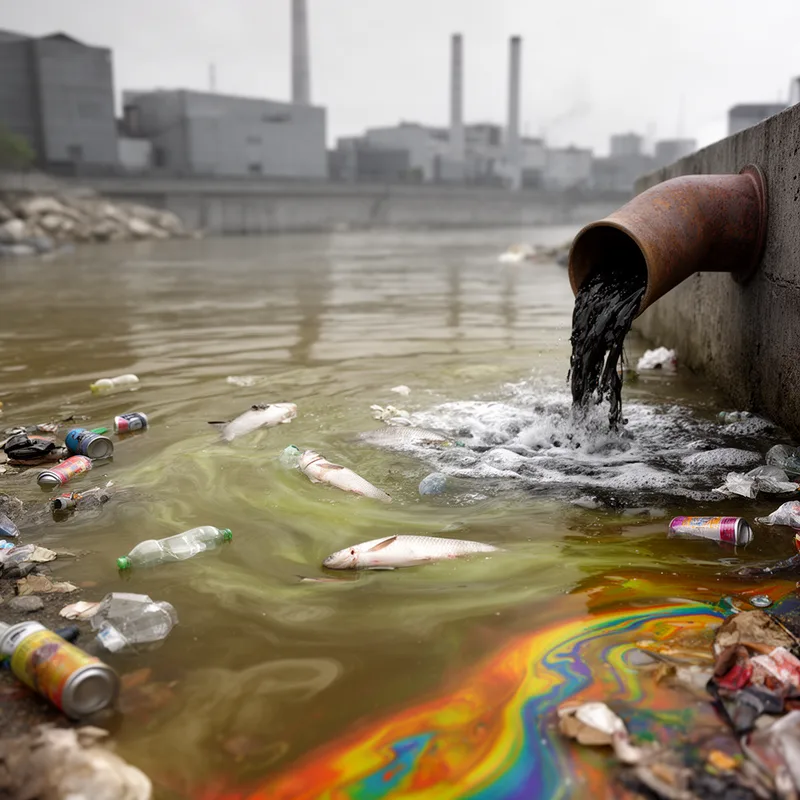
water pollution
 5
3.0
5
3.0

- noun
- /ˈwɔːtər pəˈluːʃən/
- Communities near the lake are concerned about water pollution affecting their drinking water quality.
- air and water pollution
- sources of water pollution
- water pollution control
Loading YouTube…
Watch on YouTubeLots of horrible pollution, air pollution, water pollution, a bunch of of of quite anxious stuff.
- Lots of horrible pollution, air pollution, water pollution, a bunch of of of quite anxious stuff.
Examples
-
Among the major industrial sources of water pollution are electroplating, bleaching, dyeing, and leather tanning.
Academic text (1990) -
But environmentalists now recognize "nonpoint sources" as the dominant water pollution problem in many regions.
Academic text (1999) -
Clean Water Act: The first major United States law to address water pollution.
Academic text (2011) -
Any plans for control of air and water pollution would do well to include resource conservation.
Academic text (1994) -
What effects do different kinds of water pollution have on human and wildlife habitats?
Academic text (1994) -
A growing public awareness and concern about controlling water pollution led to significant amendments in 1972.
Academic text (2011) -
The general objective of the CWA is to establish national standards to reduce water pollution.
Academic text (1999) -
More than 75% of the respondents identified water pollution as a serious problem on Roam.
Academic text (1997) -
Initially, the teacher introduces and describes the four major categories of water pollution: chemical, thermal, organic, and ecological.
Academic text (1994) -
Unfortunately, filling in rivers can worsen flooding and water pollution problems.
Antonyms
How Polluted

Surface Forms
Morphology
The meaning 'the contamination of water' is directly and transparently derived from combining 'water' (the liquid) with 'pollution' (presence of harmful substances); a B1 learner who knows both words will readily infer the compound meaning. This noun–noun composition is a common, literal, and cross-linguistically shared pattern (e.g. Spanish 'contaminación del agua'), so it is immediately comprehensible.
Etymology
Water pollution comes from a simple picture: clear water becomes dirty from pollution when factories or oil spills pour waste into rivers and lakes. That's why it means 'unsafe' or 'harmful' water for people, animals, and plants.