
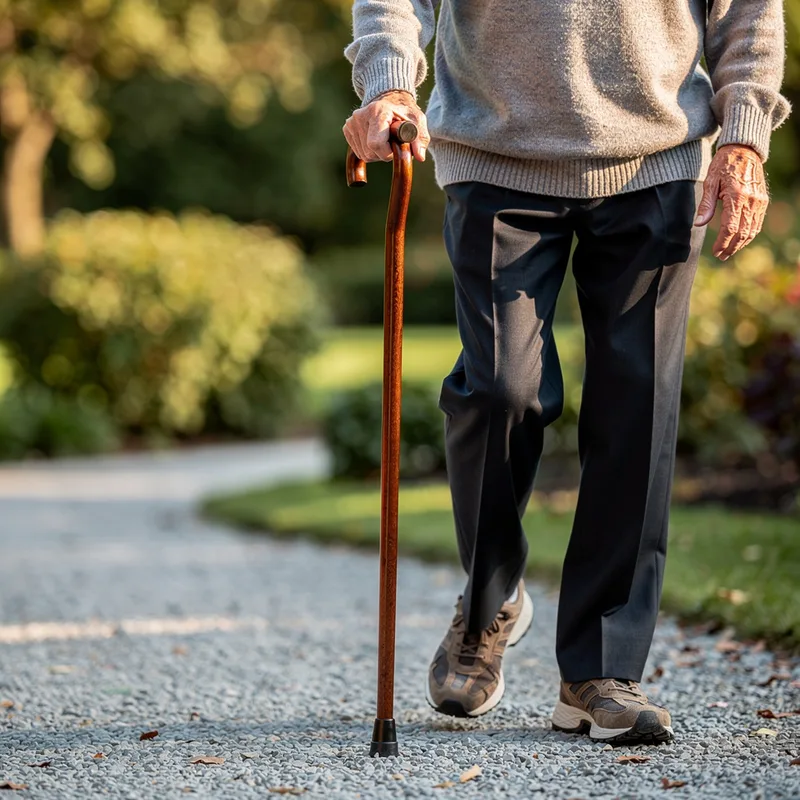
walking stick
 9
1.8
9
1.8

- noun
- /ˈwɔːkɪŋ stɪk/
- You would not part an old man from his walking stick.
- walking stick is carried
Loading YouTube…
Watch on YouTubeAnd so, but it was a very fancy carved walking stick.
- And so, but it was a very fancy carved walking stick.
- A lot of them have walking sticks, you know, yeah, because they have osteoporosis.
- Oh, so my walking stick is like red and orange and autumnal themed.
- Succeeds, makes a walking stick with a hidden high pitched whistle inside it.
Examples
-
She used her walking stick to help balance herself as she walked up the hill.
-
The old man understood anyway, and with his walking stick, waved Eddie back in the direction of the highway.
Fiction book (1998) -
I see you still have that walking stick I gave you.
-
I left my walking stick in the apartment.
-
Would you like to see my African walking stick?
-
I don't always use a walking stick.
-
He's got a walking stick.
-
Yeats held a walking stick in one hand, and a book lay open on his lap.
Fiction book (2002) -
Frank tightened his hold on his walking stick once more and listened more closely still.
Fiction book (2000) -
There was sweat on Frank's forehead now, and the hand on the walking stick was trembling.
Fiction book (2000)
Synonyms
 80
1.0
80
1.0
A long stick that helps a person walk
A walking stick made from the strong stem of a rattan palm
How Supportive

Surface Forms
Morphology
The meaning 'a stick carried in the hand to provide support while walking' is directly and transparently composed from 'walking' (relating to moving on foot) + 'stick' (a handheld rod). This simple noun + noun/attributive adjective composition is cross-linguistically common and follows regular English compounding patterns, so a B1 learner who knows both constituents will readily infer the meaning.
Etymology
Walking stick is a simple name for a stick people carry to help with walking. So the name tells you exactly what it does: it gives support and balance when you walk.