
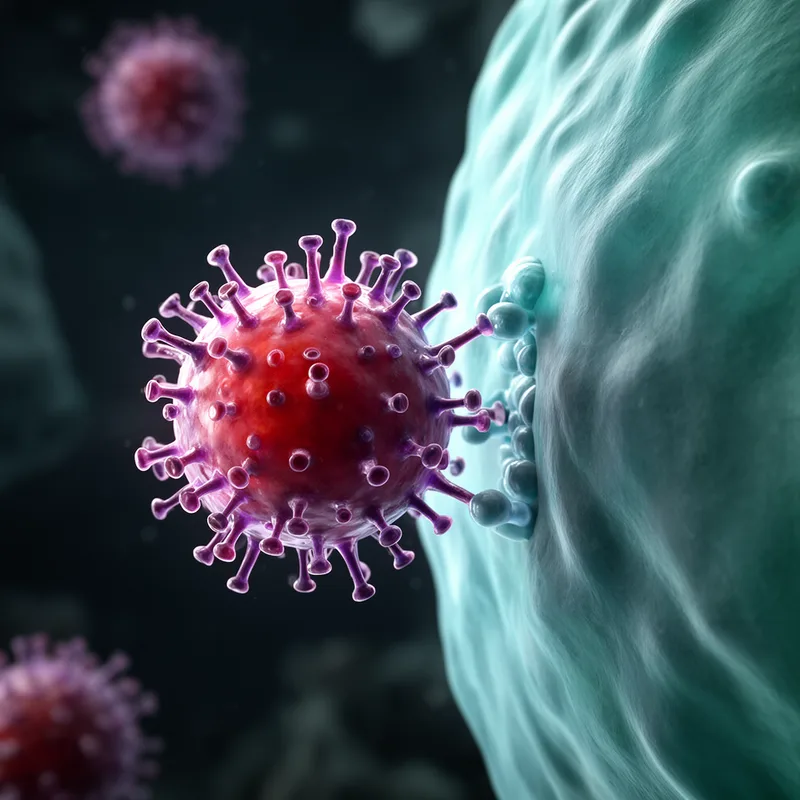
virion
 1
9.9

- noun
- /ˈvɪr.i.ɒn/
- Specialized
- The spleen and lymph nodes had the highest number of virions in both monkeys.
- intact virions
Loading YouTube…
Watch on YouTubeSo that means it's a number of virions per air volume per radius, OK.
- So that means it's a number of virions per air volume per radius, OK.
- But more specifically, if we think of virus, it'll be the virions per air volume.
- And then we needed CV, which was the concentration of virions in the liquid or in the fluid.
Examples
-
So that means it's a number of virions per air volume per radius, OK.
-
Whole-virion monovalent vaccines may perform best in a pandemic.
Blog text (13) -
There are no more virions in it.
Fiction book (1993) -
But more specifically, if we think of virus, it'll be the virions per air volume.
-
Each viral particle or virion consists of nucleic acid, either DNA or RNA, in single or double stranded form, enclosed by a capsid.
-
In the spleen, large clusters of virions were frequently seen in areas of fibrin deposition (figure).
Academic text (1995) -
Free virions were frequently observed in connective tissue and were often interspersed among fibrin deposits present in the vessels.
Academic text (1995) -
Moreover, as many as 10^9 new HIV virions are produced in an infected individual per day, and the half-life of HIV variants is about 2 days.
Academic text (1999) -
Moreover, transmission electron microscopy used to examine virus morphology showed pleomorphic virions, consistent with those of paramyxoviruses (Figure 3, panel C).
Academic text (2014) -
The virologist explained how each virion is composed of a protein coat and genetic material.
Surface Forms
Morphology
Etymology
The word virion comes from virus, which originally meant 'poison', plus the small ending -on that means 'little unit'. So a virion is like a 'little virus', the single, complete virus particle that is infectious outside a host cell.