
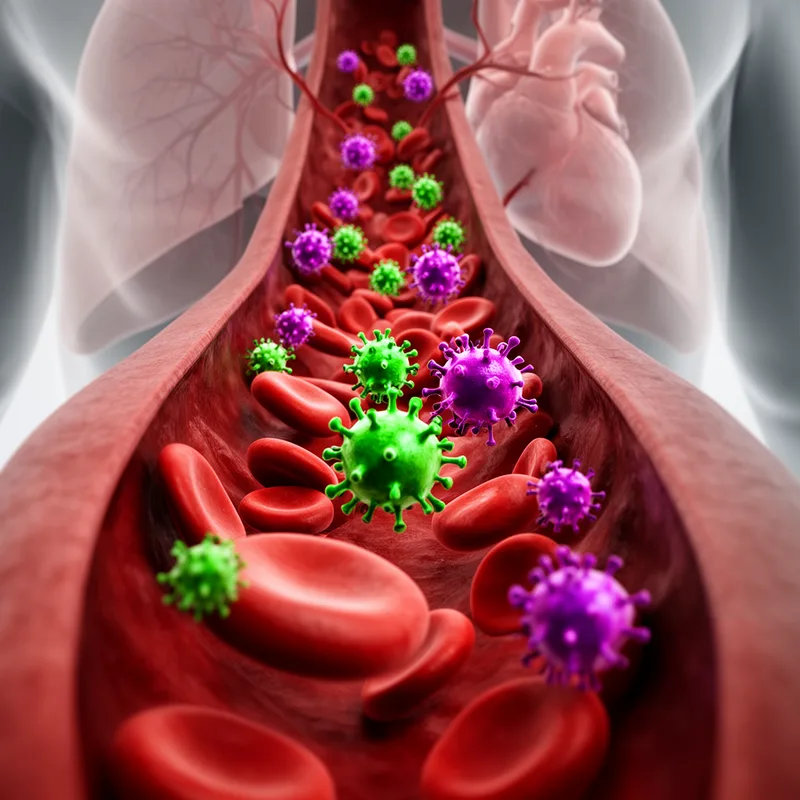
viremia


 1
9.6
- noun
- /vaɪˈriːmiə/
- Specialized
- HEV RNA was detected during viremia (median cycle threshold value 19.9, range 15.5-28.3) in feces from 8 patients with chronic illness.
Examples
-
The patient's test results confirmed the presence of viremia, indicating an active viral infection in the bloodstream.
-
By day 9, the viremia had decreased (cycle threshold 36.3); viremia was undetectable 11 days after symptom onset.
Academic text (2014) -
Even in the absence of viremia over time, two issues cloud true estimates of effectiveness.
Academic text (2007) -
Returning residents were the largest proportion of patients (96.4%) who sought treatment from the health system with dengue viremia.
Academic text (2012) -
In this study, we showed HPeV3 viremia in three patients without neutralizing antibodies within a few days after the onset of illness.
Academic text (2012) -
Conversely, continued viremia at 12 weeks implies virtually no chance that SVR will ever be attained, and continued therapy may be unwarranted.
Academic text (2007) -
Thus, we conclude that HPeV3 viremia affects many organs, including the peripheral muscles as well as the organs normally targeted by enteroviruses.
Academic text (2012) -
However, not all specimens are suitable for RT-PCR because infected persons usually exhibit a relatively short-lived viremia early in the febrile period (10).
Academic text (2012) -
We retrospectively tested samples from HEV RNA-positive patients so the antibody kinetics and viremia levels could be studied.
Academic text (2012) -
Impact of immunosuppression on the development of Epstein-Barr virus (EBV) viremia after pediatric liver transplantation.
Blog text (6)
Surface Forms
Morphology
viremia = virus (semi-transparent) = vir + emia
The relation to 'virus' is clear, but the medical suffix '-emia' (meaning a blood condition) is specialized and may be unfamiliar to general learners.
Etymology
The word viremia comes from Latin virus ('poison, germ') and the Greek ending -emia ('blood'), as in anemia. So viremia means 'virus in the blood', which explains its medical use.