
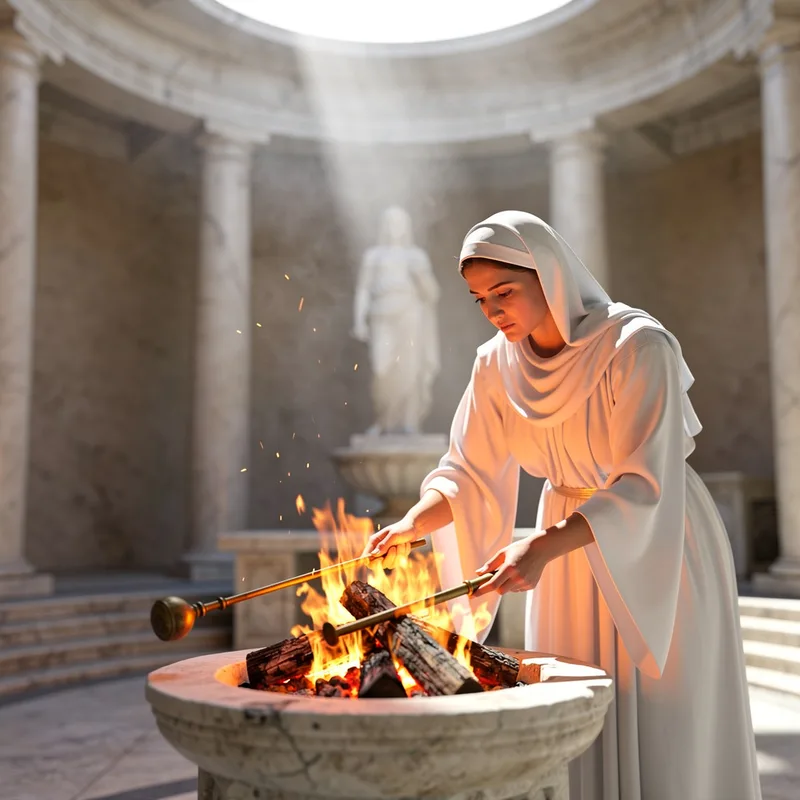
vestal virgin
 1
9.9
1
9.9

- noun
- /ˈvɛstəl ˈvɜrdʒɪn/
- Literature
- His tribades lament that their troupe is "Nothing so fine, nothing so great as the establishment of the vestal virgins in Rome."
- sixteen vestal virgins
- vestal virgins in Rome
Examples
-
The keepers of the flame were the six Vestal virgins chosen from Rome's leading families.
-
In ancient Rome, Vestal virgins were priests of Vesta who were dedicated to the Roman goddess Vesta.
-
make way for the vestal virgin
-
Now, uh, if you'll excuse me, I have to go book a vestal virgin.
-
You could stand there naked with a mattress strapped to your back and still look like a vestal virgin.
-
The vestal virgins assured the success and sanctity of ancient Rome.
-
Feel free to treat this as a pop theory popped out by an amateur (I certainly do), but our goddesses are not pristine submissive vestal virgins in white, spending their days in seclusion.
Blog text (30) -
In ancient Rome, the vestal virgin was revered for her role in maintaining the sacred fire in the temple of Vesta.
-
The duties of a vestal virgin included vow of celibacy and the careful upkeep of Vesta's sacred flame.
-
Chosen from Rome's noblest families, each vestal virgin played a crucial role in the spiritual life of the city.
Synonyms
 39
7.2
39
7.2
A woman who leads religious ceremonies
 1
9.9
1
9.9
A woman who does not have sex and often cares for a sacred fire
Surface Forms
Morphology
Both constituents contribute directly: 'vestal' refers to Vesta/Roman priestesses and 'virgin' denotes a woman who has never had sex, so their combination clearly yields a Roman priestess dedicated to Vesta who is celibate. The compound is historically literal rather than idiomatic and follows a transparent noun–noun compositional pattern that a learner who knows the parts can readily infer.
Etymology
Vestal virgin comes from ancient Rome: Vestal refers to the goddess Vesta and virgin means a woman who must stay unmarried and 'pure'. These women kept a sacred temple fire burning, so the phrase means a woman chosen for a holy, protected duty.