

vespertilian bat
- noun
- /ˌvɛspərˈtɪliən bæt/
- Specialized
- The vespertilian bat hunts insects using echolocation during the twilight hours.
Examples
-
Unlike fruit bats, a vespertilian bat typically preys on insects.
-
Scientists observed several species of vespertilian bat roosting in the abandoned mine.
-
The vespertilian bat is known for its echolocation abilities.
-
Many vespertilian bats can be found in North America.
-
The vespertilian bat is often seen flying at dusk, capturing insects in mid-air.
-
Researchers found that a vespertilian bat can consume up to 600 mosquitoes in one night.
-
In the cave, a colony of vespertilian bats hung upside down, resting during the day.
Synonyms
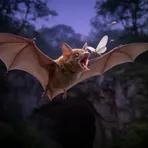
A bat that eats insects and lives in many parts of the world
Surface Forms
Morphology
vespertilian + bat
The structure is a straightforward adjective + noun composition: if a learner knows 'vespertilian' means 'of or relating to the Vespertilionidae' and 'bat' means the flying mammal, then 'vespertilian bat' directly means 'a bat belonging to that family.' Although 'vespertilian' is a rare, taxonomic adjective, the meaning of the phrase is compositional and thus predictable from its parts.
Etymology
Vespertilian bat comes from the old word vesper, meaning 'evening', because these bats are most active at dusk and hunt insects then. So the name helps you remember a bat that is awake at 'evening' and catches insects.

