

vervet
 1
8.3
1
8.3

- noun
- /ˈvɜrvɪt/
- South African
- Leopards, for example, are the only predators that cache carcasses in trees, and vervets invariably alarm call when they spot a leopard in a tree with a carcass.
- vervet monkey
Examples
-
While each vervet female inherits her high or low status, this does not mean that she accepts her lot in life without protest.
Academic text (1990) -
To cite one example, when vervet males spot a leopard, one of their primary predators, they give loud barking alarm calls that cause other vervets to run up into trees for safety.
Academic text (1990) -
In Amboseli, predation accounts for more than 70 percent of all vervet deaths.
Academic text (1990) -
These snakes hunt vervets by lying in wait for them in bushes or at the base of trees.
Academic text (1990) -
Unlike the much larger baboons, the vervets seldom stray far from the safety of the trees.
Academic text (1996) -
For the past thirteen years, we and our colleagues have attempted to tackle some of these questions by studying the East African vervet monkey in Kenya's Amboseli National Park.
Academic text (1990) -
In Amboseli—an arid savanna woodland punctuated by swamps at the foot of Kilimanjaro—vervets live in groups of ten.
Academic text (1990) -
The vervet monkey quickly climbed a tree to escape from a nearby predator.
-
Vervet monkeys are often seen playing together in the trees of the savanna.
-
A group of vervets foraged for fruit under the hot African sun.
Synonyms

A small East African monkey called the vervet with white and greenish fur and white hair beside its face
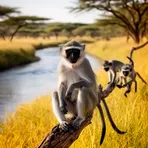
A small African monkey with a black face and hands that lives in woods and grassland
Compounds
- South African
A small African monkey with a black face and hands that lives in woods and grassland
Surface Forms
Etymology
Vervet probably comes from the French root vert ('green') plus the small ending -et ('little'), so it originally meant a 'little green one'. That's a helpful way to remember the name, because the vervet monkey has a greenish-grey coat, which is why the name fits the animal.