
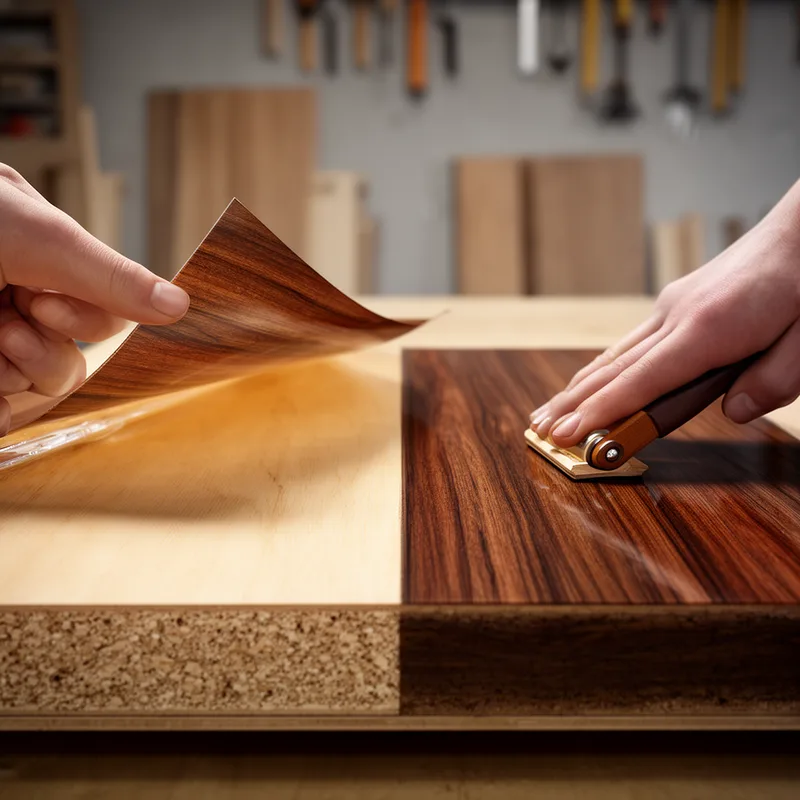
veneering
- noun
- /vəˈnɪrɪŋ/
- Specialized
- I will use my old hydraulic press to firmly glue the veneer to the notebooks.
Examples
-
The craftsman demonstrated his skill by applying veneering to the wooden cabinet, giving it a beautiful finish.
-
So these strips will allow you to place the veneer on top for alignment without risk of unwanted sticking.
-
It is generally assumed that, to avoid chipping for tooth-supporting restorations, a consistently thick layer of veneering ceramic must be guaranteed by the tooth-analog abutment and structure design 35.
Academic text (2016) -
Using veneering, the artisan enhanced the beauty of the desk with a thin layer of rich mahogany.
-
She chose veneering for her table to enhance its appearance with luxurious wood grain.
Synonyms

 35
3.4
35
3.4

A layer of material that covers a surface to protect or decorate it
A thin layer on wood or metal that protects and looks good
Antonyms
How Thick

Surface Forms
Morphology
Etymology
Veneering comes from the old word veneer, which meant 'to cover'. It describes the process of putting a thin, fancy wood 'cover' on plain surfaces, so veneering means the act of applying that thin layer to make things look better.