
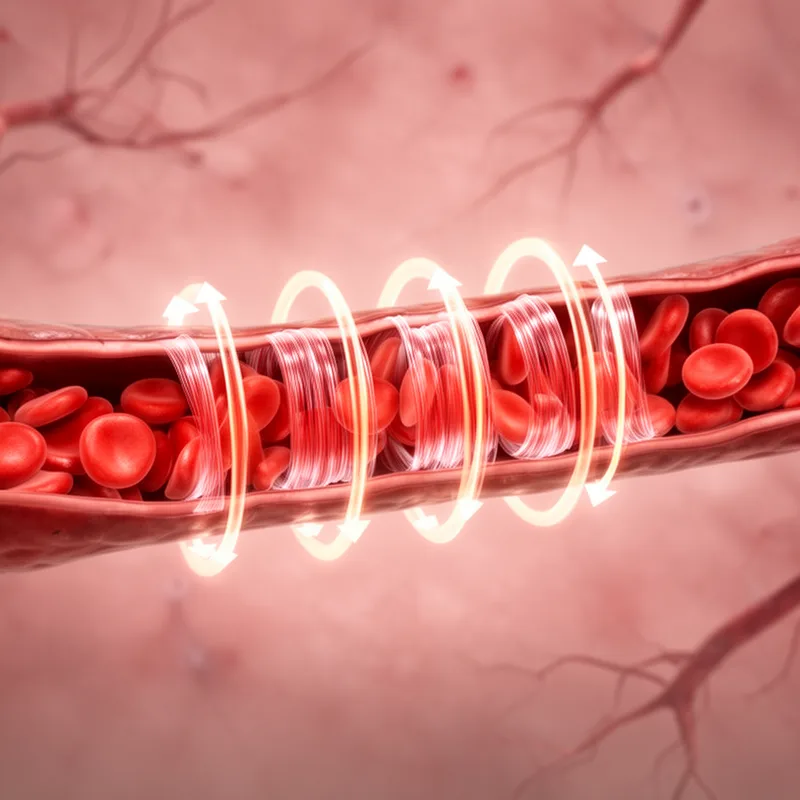
vasomotion
- noun
- /ˌveɪzoʊˈmoʊʃən/
- Specialized
- During the experiment, researchers monitored vasomotion to understand how blood flow is regulated under different conditions.
- vasomotion is generally associated
Examples
-
In addition, we found indirect evidence that vasomotion was significantly affected by changes in temperature.
Academic text (1999) -
Evidence of vasomotion, as reflected by oscillations in perfusion, was also observed in the present study.
Academic text (1999) -
In rats, vasomotion is generally associated with power in the lowest frequency range (10).
Academic text (1999) -
A similar temperature-mediated effect of increasing vasomotion frequency and amplitude was reported in man (25, 26) and in the bat (27).
Academic text (1999) -
No increase in perfusion (Table 1) or vasomotion (Table 2, low frequency content) with heating was seen at 73 mmHg.
Academic text (1999) -
Vasomotion, as manifested by oscillations in skin perfusion, has been described by others (23, 24).
Academic text (1999) -
The responses presented in Figure 3 between 28 and 30 Celsius do not show the suggested correlation between increasing P m and increasing spectral power in the low frequency range (an indicator of vasomotion).
Academic text (1999) -
Increased temperature caused a threefold increase in spectral power of control perfusion, with the majority of change occurring in the low range (<1.0 Hz), the range in rats thought to be associated with vasomotion (10).
Academic text (1999) -
Increased temperature also caused low-frequency oscillations of arterioles to increase, suggesting possible increased vasomotion and decreased vascular resistance. Increased temperature caused skin to become stiffer in response to increased surface pressure.
Academic text (1999) -
Power in the low frequency (<1.0 Hz) range of perfusion in rats has been thought to be associated with vasomotion (10), while power between 1 and 3.5 Hz has been associated with respiration-induced changes, and that between 3.5 and 5 Hz with the cardiac cycle.
Academic text (1999)
Surface Forms
Morphology
Etymology
The word vasomotion comes from vaso- (from Latin vas, 'vessel') and -motion ('movement'). So it literally means 'movement of vessels', which helps you remember the rhythmic opening and closing of blood vessel walls that controls blood flow.

