
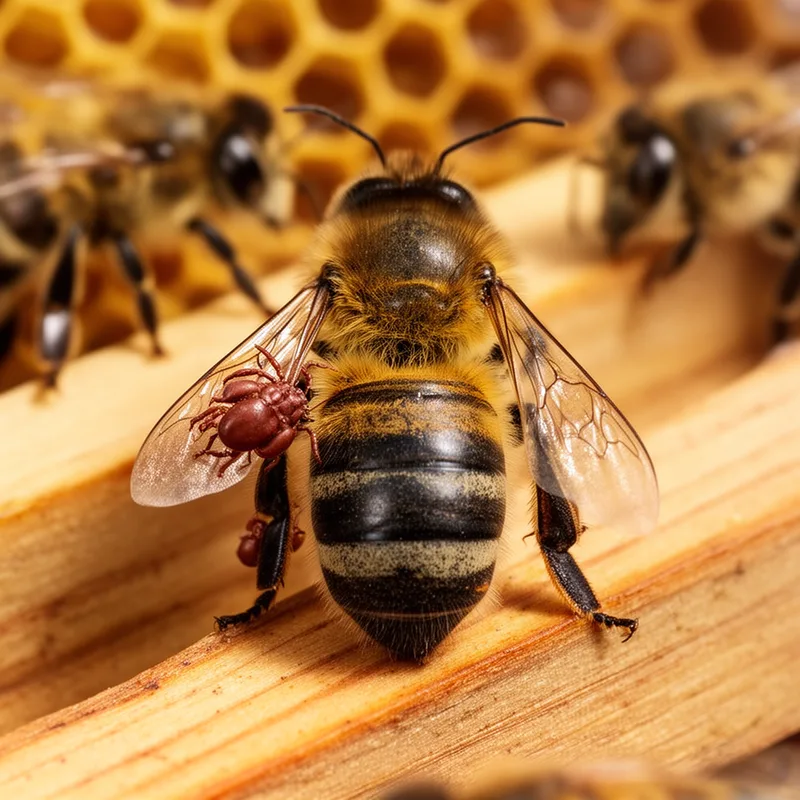
varroa


 1
9.9
- noun
- /vəˈroʊə/
- Specialized
- Varroa destructor is the number-one threat to honey bees worldwide.
- varroa mite
- varroa mite feeds
Examples
-
What's more, varroa mites are thought to transmit at least a half-dozen bee viruses.
Academic text (1999) -
Visible as a dark oval shape, an adult female varroa mite feeds on the midsection of a developing worker bee.
Academic text (1999) -
Varroa mites are a serious threat to honey bee colonies.
Academic text (2011) -
A family of varroa mites was found at the bottom of a honey bee brood cell.
Academic text (1999) -
Varroa mites feed on the blood of adult bees and developing young bees that are still soft, white pupae.
Academic text (1999) -
An eight-legged, blood-sucking parasite known as the varroa mite ranks as one of the worst enemies of honey bees worldwide.
Academic text (1999) -
The standard treatments for Varroa mites are chemical-based miticides, such as fluvalinate and coumaphos.
Academic text (2004) -
Varroa mites may camouflage themselves by aligning their setae with the hairs on the bee's body.
Academic text (2000) -
Varroa mites have been implicated in the spread of a pathogen known as Kashmir bee virus, but scientists don't yet know the mites' exact role.
Academic text (1999) -
The varroa mite is a major culprit in honeybee deaths.
Surface Forms
Etymology
Varroa is a scientific name for a very small parasitic mite that attacks honey bees. A helpful way to remember it is to think of varroa as the special name for the little 'bee mite', which is why varroa means the parasite itself.