
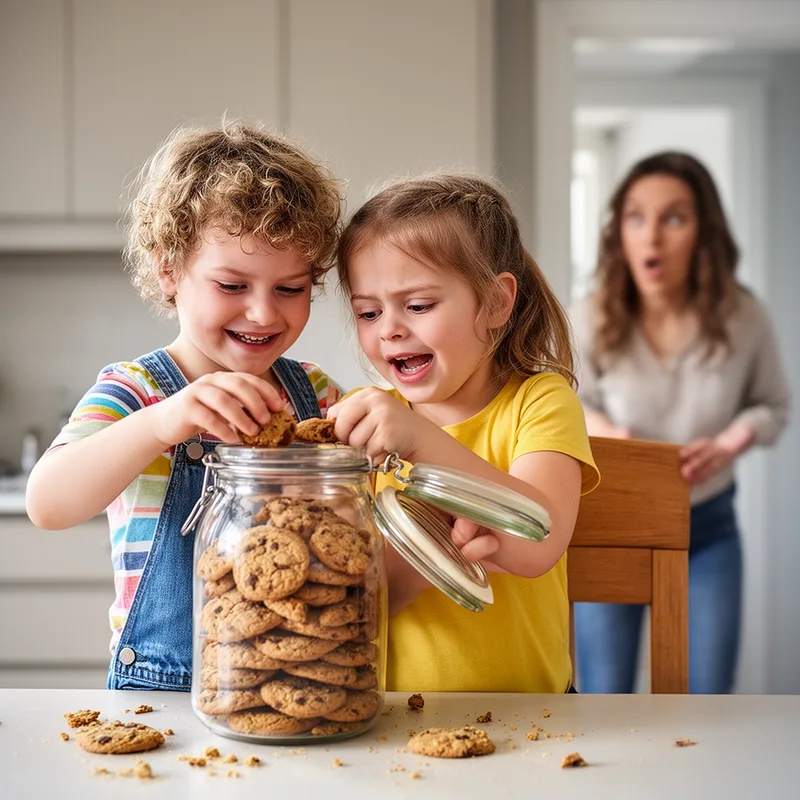
up to mischief
- idiom
- Informal
- She loved to see her little brother up to mischief, as it always made her laugh.
- get up to mischief
Examples
-
He's been up to mischief, that's for sure.
-
The children were frequently up to mischief, playing pranks on their neighbors.
-
There were always plenty of things to do and always up to mischief, going places where you shouldn't go.
-
I can tell by her eyes she's up to mischief.
Fiction book (1999) -
She's here to catch naughty boys up to mischief.
-
Who's to say they are not deflecting attention away from themselves and are up to mischief?
Blog text (14) -
"The minions of Atoris the Evil," a voice answered, "doubtless up to mischief."
Fiction book (1991) -
The parents of Emily and Ned sensed that their children were concealing something from them and suspected that the two were up to mischief of some kind.
Fiction book (1996) -
Whenever the dog is left alone, you can be sure he is up to mischief in the backyard.
Synonyms

 19
3.5
19
3.5

Causing playful trouble that is not harmful
 19
7.0
19
7.0
Doing something secret that may be wrong or harmful
 2
7.4
2
7.4
A child who acts in a foolish or playful way


 1
8.1
1
8.1
To play and joke in a silly way and sometimes cause trouble

Doing small naughty things for fun
Antonyms


How Mischievous
49
3.9

- Informal
- Informal
33
4.8
79
1.6
25
2.8
Surface Forms
Morphology
The noun 'mischief' clearly denotes playful or troublesome behavior, so that constituent is transparent. However, the relational phrase 'up to' meaning 'engaged in' is a conventionalized pattern that is not fully predictable from the literal senses of 'up' + 'to', so a learner who knows the words may only partly infer the full idiomatic sense without prior exposure.
Etymology
Up to mischief comes from everyday talk where up to means 'busy with' and mischief means playful trouble. Picture a quiet child sneaking around doing small naughty things; they are literally 'up to' trouble, so the phrase means 'engaged in playful or mildly troublesome behavior'.