
to unroll


 1
7.9
1
7.9
- verb
- /ʌnˈroʊl/
- Specialized
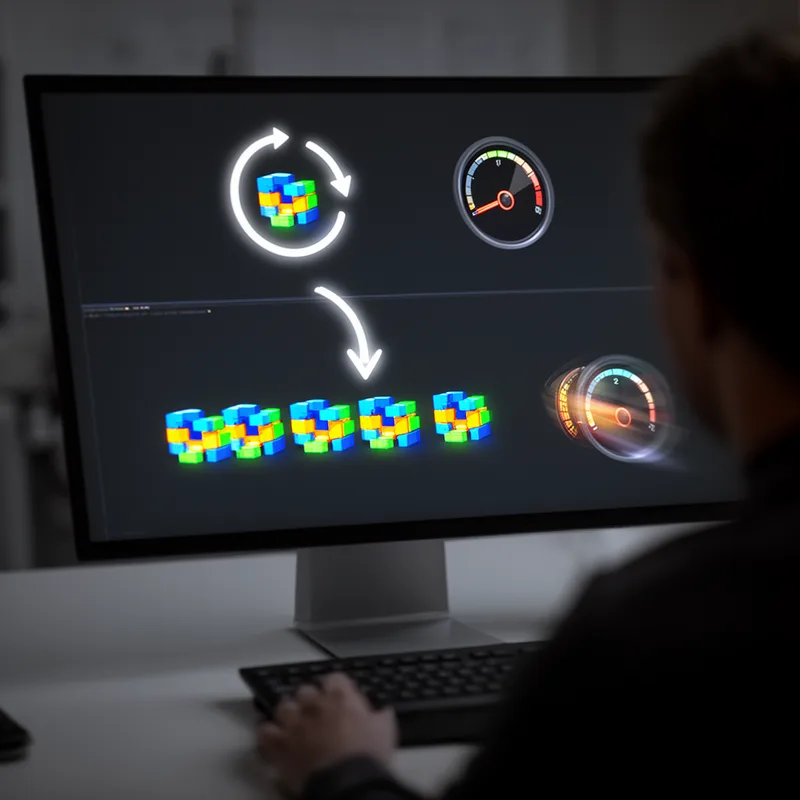
- To improve performance, many compilers choose to unroll loops during optimization.
- unrolled loop
- unrolled iteration
- unrolled inner loop
Loading YouTube…
Watch on YouTubeSo you have you can unroll that that model in time.
- So you have you can unroll that that model in time.
- As you know, this is it's kind of an end point of unrolling code.
- OK, so just these some checks, you kind of unroll them, unravel them and you get a PCP with polylog and queries.
- And you're and that's why you're saying it's just the computation, A deterministic thing that's just unrolling.
Examples
-
If we unroll the loop by two, we can achieve a slightly better scheduling of the instructions.
Academic text (1994) -
By unrolling all three nested loops, all variables in the loop can be reused.
Academic text (1994) -
The loop is on the length of the inner product and is unrolled by four.
Academic text (1994) -
The degree of loop unrolling is generally limited by the number of registers available.
Academic text (1994) -
For example, unrolling a loop by eight is equivalent to using a vector length of eight.
Academic text (1994) -
The question is, "Can we get a higher level of performance by further unrolling the loop(s)?"
Academic text (1994) -
Here all loops have been unrolled; this means that for every line in the code, the indices are constant.
Academic text (2000) -
First, inner loops are unrolled to expose more independent instructions per iteration.
Academic text (1994) -
In its simplest form, unrolling a loop amounts to a mini-vectorization of the loop.
Academic text (1994) -
Before the application of any of the instruction scheduling techniques, inner loops are unrolled where heuristics suggest a benefit.
Academic text (1994)
Surface Forms
Morphology
Etymology
Unroll in programming uses the same idea: un- ('reverse') and roll ('to turn into a tube'). Think of a rolled map — you unroll it and lay it flat; in code, to unroll a loop is to copy its steps so the program repeats less work and runs faster.