

unlubricated
- adjective
- /ˌʌnˈluːbrɪˌkeɪtɪd/
- The unlubricated pieces would be stuck, if temporarily. Of more importance to high-speed applications such as turbines, however, was that no matter how low the bearing friction was, heat would build up, requiring elaborate cooling mechanisms.
Examples
-
Interestingly, much of Leonardo's writing on friction did not come to light until the 1960s, which is why the individual more often associated with the laws of friction is Guillaume Amontons, who independently studied both lubricated and unlubricated friction at the end of the 17th century.
Academic text (1998) -
That's right, he implied former state senator Troy Jackson was subjecting Mainers to an unlubricated fucking, but...
-
These two extraordinarily simple empirical laws hold true under a remarkably large set of sliding conditions, both lubricated and unlubricated.
Academic text (1998) -
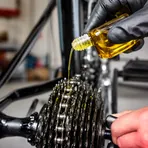
In mechanical systems, unlubricated parts can lead to excessive wear and tear.
-
The engine started making noise because it was running on unlubricated components.
-
Using an unlubricated surface in the experiment caused the materials to stick together.
Synonyms


Antonyms
How Lubricated

Surface Forms
Morphology
unlubricated = lubricated (transparent) = un + lubricate + ed
Formed by applying the negative prefix 'un-' to the adjective 'lubricated' (from 'lubricate' + -ed), a straightforward negation.
Etymology
The word unlubricated breaks into un- meaning 'not' and lubricate meaning 'to make slippery', which you can also see in the common word lubricant. So unlubricated means 'not made slippery', which is why moving parts can stick, wear out, or make loud noises.