
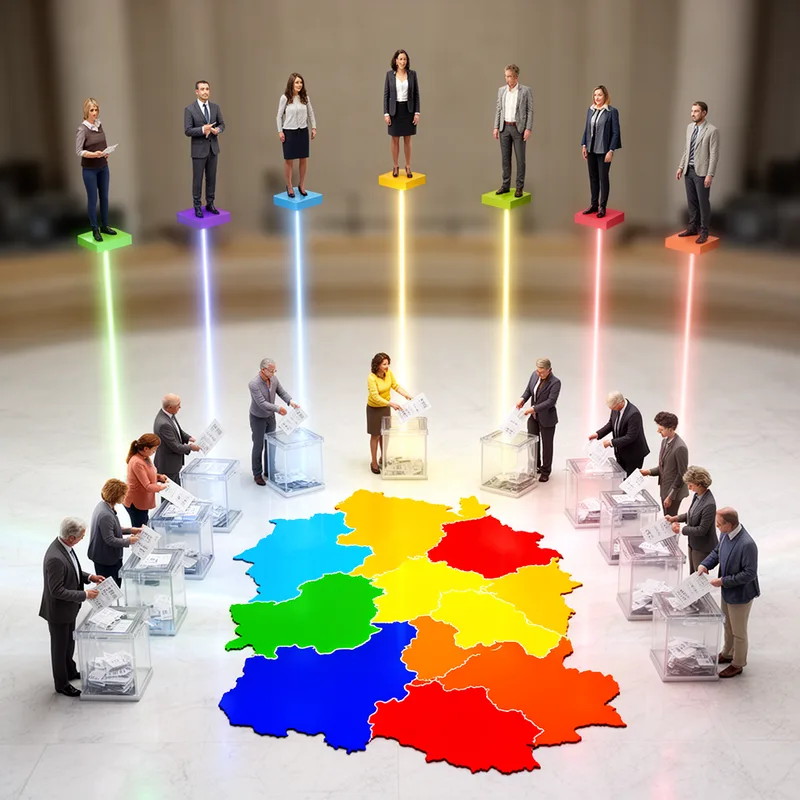
uninominal system
- noun
- /ˌjuːnɪˈnoʊmɪnəl ˈsɪstəm/
- Specialized
- In a uninominal system, each constituency elects one representative, making it easier for voters to choose a candidate directly.
- a pure uninominal system
Examples
-
The "pure uninominal system" (not yet implemented) in which all members of Congress and of city councils are elected on the basis of winning a majority of the votes cast in their single-member voting district; this system completely eliminates proportional representation.
Academic text (1993) -
Under the uninominal system, it would be possible for the nation's largest party to secure an overwhelming majority of congressional seats if it were to win in most of the country's voting districts.
Academic text (1993) -
Undoubtedly, the uninominal system, which held out the prospect of winning an election without party backing, encouraged political newcomers and activists alike to challenge the established parties.
Academic text (1993) -
At the other end of the spectrum, national leaders of the neighborhood movement pointed out that the reform fell far short of the "pure uninominal system" (in which proportional representation is eliminated altogether) which they had been advocating.
Academic text (1993) -
On the other hand, national leaders for the neighborhood associations viewed the partial uninominal system as only a half-measure, insufficient to alter the established pattern of electing candidates according to their party labels, rather than on their qualifications for the job.
Academic text (1993) -
To correct the situation, many proposed that the system of party-devised slates be replaced with a "pure uninominal system" of elections, a proposal that implied doing away with proportional representation entirely, and which was thus generally not endorsed by national party leaders of any stripe.
Academic text (1993) -
The 'partial uninominal system" (the 1992 municipal elections) in which 2/3rds of all councilmen were elected in single-member voting districts (one councilman per electoral circuit).
Academic text (1993) -
The implementation of a uninominal system can lead to clearer election outcomes, as only one candidate is elected from each district.
-
Many countries have adopted a uninominal system to streamline their electoral process and reduce political fragmentation.
Synonyms

A voting system in which each area elects one representative

Each district elects one representative
Surface Forms
Morphology
The meaning is compositional: 'uninominal' specifies the ‘one-representative-per-district’ property and 'system' denotes a set of rules or arrangement, so together they straightforwardly mean an electoral system electing one representative per constituency. While 'uninominal' is technical and low-frequency, a learner who already knows both constituents can infer the phrase meaning without further exposure.
Etymology
Uninominal system comes from old Latin parts uni meaning 'one' and nominal meaning 'name', so it literally means 'one name'. That's why the phrase describes an election system where each district chooses only one representative.

