

undernourishment


 1
5.7
1
5.7
- noun
- /ˌʌndərˈnʊrɪʃmənt/
- Specialized
- Many children in developing nations suffer from undernourishment due to lack of access to sufficient food.
Examples
-
It will be a slow extinction from apathy, indifference, and undernourishment.
Blog text (2) -
Consequently, despite the population increase, the number of people suffering from chronic undernourishment in developing nations decreased from 917 million (or 35% of the population) in 1969-1971 to 839 million (21% of the population) in 1990-1992 (FAO 1996d).
Academic text (1998) -
Progressive and long-term undernourishment ends in hair loss.
Blog text (28) -
32 undernourishment diseases
Academic text (1991) -
In those days, nearly everyone lived on the edge of starvation, and wintertime deaths due to undernourishment-caused diseases were common.
Blog text (29) -
Incidence of undernourishment stood at 970 million in 1970, comprising one-third of people in developing countries at the time.
Academic text (2003) -
A life similar to the former Soviet Union and Cuba, with empty grocery shelves, equal misery, starvation, mediocrity, undernourishment, alcoholism, potatoes, and vodka.
Blog text (32) -
It is estimated that by the mid-1980s, at least 30 percent of the Moroccan population was too poor to afford enough food to prevent serious undernourishment (World Bank 1989).
Academic text (1992) -
Significantly, for those who routinely rely on rice for a meal and, on good days, rice and fish, undernourishment is often referred to as sakrifisiu (sacrifice) or nesisidadi (necessity), and not as food deprivation per se.
Academic text (2008) -
Subsequently, catch and revenue losses resulting from overfishing and overcapacity are disproportionately affecting the livelihoods of small, local fishers as well as the food security of developing nations with widespread undernourishment that heavily depend on fish as a vital source of food.
Academic text (2017)
Synonyms
 266
1.0
266
1.0
A feeling of weakness and discomfort when you need food
 83
4.7
83
4.7
A very strong hunger that happens when someone has no food for a long time
 29
5.1
29
5.1
A health problem when the body does not get or use the right food
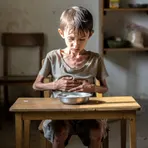 2
4.8
2
4.8
Not having enough food and nutrients to be healthy and grow
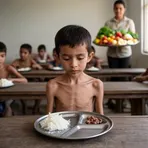 1
6.0
1
6.0
A lack of enough food and the nutrients a body needs for good health
 1
8.6
1
8.6
Extreme thinness from not enough food or illness

A state of having less food than the body needs but not completely without food

A strong need for food that makes you want to eat
Antonyms

How Nourished

Surface Forms
Morphology
undernourishment = nourishment (transparent) = under + nourish + ment
Formed by adding 'under-' (insufficient) to 'nourishment' (food), so the meaning 'insufficient nourishment' is directly inferable.
Etymology
Undernourishment combines under- ('not enough' or 'below') and nourish ('to feed', the same root as nutritious), so it means not getting enough food to grow or work well.