

tympanic cavity
- noun
- /tɪmˈpænɪk ˈkævɪti/
- Specialized
- The tympanic cavity plays a crucial role in hearing by housing the tiny bones that transmit sound vibrations.
Examples
-
Myoclonus of the middle ear is a rare condition characterized by abnormal repetitive muscle contractions of the tympanic cavity.
Academic text (1998) -
In 2003, Kriukov et al. reported good results with mitomycin C in preventing scar formation in tympanic cavities during surgery on patients with suppurative otitis media.
Academic text (2005) -
The LED was placed inside the auditory canal of four dogs, and the photovoltaic cell was placed in the tympanic cavity over the cochlear promontory.
Academic text (1995) -
During the examination, the doctor assessed the condition of the tympanic cavity to check for any abnormalities.
-
Infections in the tympanic cavity can lead to hearing loss if left untreated.
Synonyms

 4
3.5
4
3.5

A space filled with air behind the eardrum that contains three tiny bones that carry sound to the inner ear
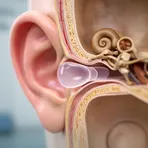
The part of the ear between the outer ear and inner ear that includes the eardrum
Surface Forms
Morphology
The phrase is a straightforward adjective + noun composition: 'tympanic' (relating to the eardrum) + 'cavity' (a hollow), so it denotes the hollow space associated with the tympanum/middle ear. Although medical, the meaning is directly derivable from the parts and follows a common compositional pattern, so a learner who knows both words will understand it.
Etymology
The noun tympanic cavity comes from words that mean tympanic 'drum' and cavity 'space'. It is a small space behind the eardrum that holds tiny bones that pass sound to the inner ear, so the name gives a clear picture and explains why it means the main cavity in the middle ear.