
two-body problem
- noun
- /ˈtuːˈbɑːdi ˈprɒbləm/
- Specialized
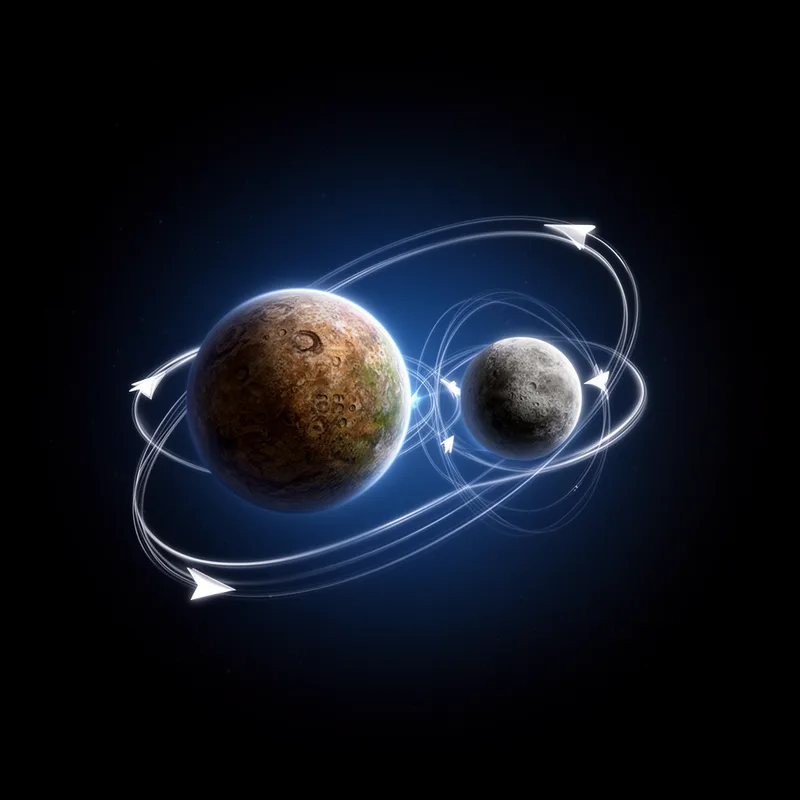
- In the late 17th century, Isaac Newton solved what was then known as "the two-body problem," describing the orbital motion of one celestial body, such as a planet, about another body, such as the Sun.
Examples
-
The equations of motion are perfectly well-behaved for a two-body problem.
Blog text (29) -
Think of the difference between solving a two-body problem and an n-body problem.
Blog text (23) -
Solving the two-body problem often requires complex equations that account for gravitational interactions.
-
The physicist explained how the two-body problem accurately predicts the motion of planets around the Sun.
-
In classical mechanics, the two-body problem simplifies the study of gravitational forces between two objects.
How Difficult


Surface Forms
Morphology
two-body + problem
The parts 'two' + 'body' + 'problem' give a general clue that this is a problem involving two people or entities, so a learner could guess some relation to a difficulty between two parties. However, the specific academic/dual-career sense ('partners both seeking employment in the same area') is specialized and not derivable from the literal constituents (and may be confused with the physics 'two-body problem'), so prior exposure is needed for the precise meaning.
Etymology
Two-body problem comes from physics and paints a simple picture: imagine two bodies, like planets, that pull on each other and you must work out how they will move. That's why it means 'predicting the motion of two interacting bodies'.