
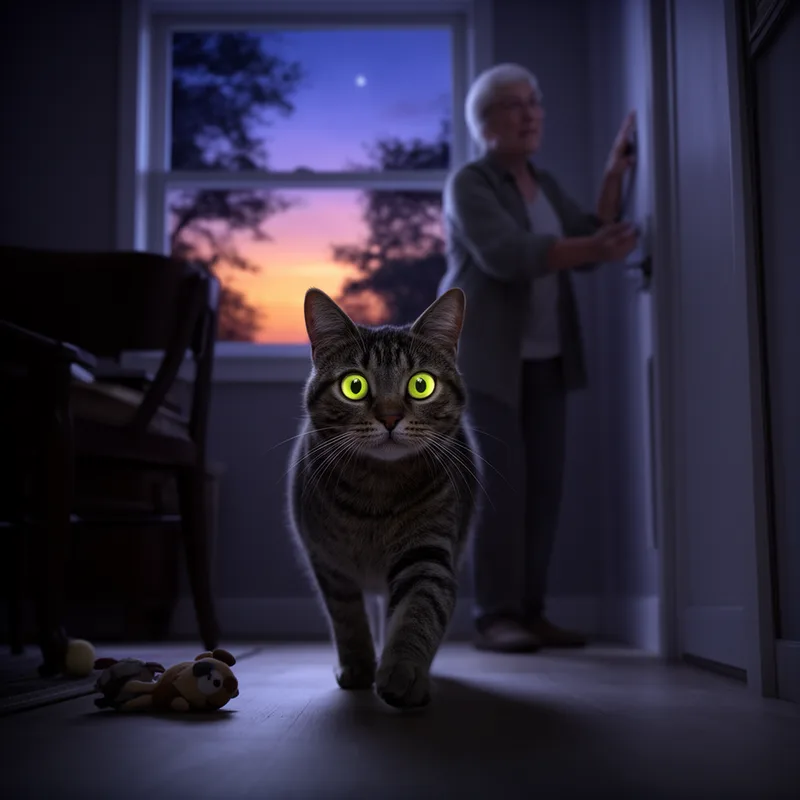
twilight vision
- noun
- /ˈtwaɪlaɪt ˈvɪʒən/
- As we age, our twilight vision often deteriorates, making it harder to drive at night.
Examples
-
Owls have remarkable twilight vision, allowing them to hunt efficiently at dusk.
-
Cats rely on their twilight vision to navigate through dimly lit environments.
-
Owls have excellent twilight vision for hunting.
-
Many animals rely on twilight vision to hunt at dusk.
-
Cats rely on their twilight vision to navigate through dimly lit environments.
-
Owls have remarkable twilight vision, allowing them to hunt efficiently at dusk.
-
Many animals rely on twilight vision to hunt at dusk.
Synonyms
 11
3.8
11
3.8

Ability to see in low light or darkness

Being able to see in low light, for example at night

To see in very low light, for example at night
Antonyms
 70
3.1
70
3.1
A condition in which a person cannot see because of injury, disease, or being born that way

How Well

Surface Forms
Morphology
The meaning 'the ability to see in reduced illumination' is transparently composed from 'twilight' (dim light at dusk/dawn) + 'vision' (capacity for seeing), so a B1 learner who knows both constituents can readily infer the phrase. This noun–noun (or adjective-noun) descriptive pattern is cross-linguistically common and follows regular English compounding, making the expression predictable.
Etymology
Twilight vision may come from the image of animals like cats and owls moving easily at twilight, the dim time after sunset, because of their strong vision. So it means 'the ability to see in low light'.