

turning and boring mill
- noun
- Specialized
- With the turning and boring mill, engineers can create precise cylindrical shapes from massive steel blocks.
Examples
-
The factory installed a new turning and boring mill to handle oversized metal components.
-
Operators must be specially trained to use the turning and boring mill safely and efficiently.
-
The turning and boring mill is essential for large-scale manufacturing.
-
Can you operate a turning and boring mill effectively?
-
The factory installed a new turning and boring mill to handle oversized metal components.
-
Operators must be specially trained to use the turning and boring mill safely and efficiently.
-
With the turning and boring mill, engineers can create precise cylindrical shapes from massive steel blocks.
Synonyms

 1
5.6
1
5.6

A tool with a spinning cutter that cuts and shapes metal and other hard materials
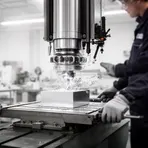
A machine that cuts or shapes metal with rotating cutters

A tool that cuts metal or wood by moving one cutting part back and forth
Surface Forms
Morphology
The phrase is a straightforward compositional label: a 'mill' (machine/facility) that performs the processes 'turning' and 'boring', so the overall meaning is directly derivable from its parts. Although the term is technical, the coordination of two known process nouns with 'mill' follows regular English noun-modifier patterns (and has clear cross-linguistic parallels), so a B1 learner who knows the constituent words can infer the meaning.
Etymology
Turning and boring mill gets its name from the two jobs it does: turning means the heavy metal piece is rotated so a cutting tool can 'shape' its outside, and boring means a tool 'makes' or enlarges a hole inside. That's why a mill with this name is a large machine for shaping and making holes in big parts by turning them.