

tug of war
 4
2.0
4
2.0

- noun
- /tʌg əv wɔr/
- During the festival, teams competed in a friendly tug of war to see who was the strongest.
- play tug of war
- win a tug of war
- tug of war rope
Examples
-
At the 2012 TAP Olympics, Leonard pulled out a monstrous win in a round of tug of war, helping to decimate the visiting West Coast team and represent NYC.
Blog text (4) -
Out front, two six-year-olds in Star Wars tee-shirts play tug-of-war with a Stretch Armstrong doll.
Fiction book (1999) -
Look, it's a regular tug of war.
-
We have a tug of war.
Fiction book (1997) -
We'll have a tug of war.
Fiction book (1997) -
This is a traditional tug of war with four different groups in competition against each other.
Academic text (2007) -
And the winner of the tug of war contest is drum roll, please.
-
Sneve drove him up to campus in the Bummobile Thursday night to oversee the frosh-soph tug-of-war.
Blog text (12) -
"I was playing tug-of-war with my puppy," he said, "and his tooth fell out!" I couldn't help but wonder why anyone would be playing tug-of-war at two A.M., but I patiently explained that puppies have baby teeth and that it is normal for them to fall out.
Fiction book (1999) -
The children had a great time playing tug of war during the school picnic.
Synonyms
 3
3.0
3
3.0
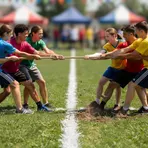
A contest where two teams pull a rope to drag the other team across a line
Antonyms


Surface Forms
Morphology
The meaning is directly derivable from the parts: 'tug' = a pull and 'war' used figuratively as a struggle, so 'tug of war' transparently describes a contest of pulling. This noun‑of‑noun compositional pattern is cross‑linguistically common and follows regular English combination rules, so a B1 learner who knows the constituents will readily infer the meaning.
Etymology
Tug of war comes from a simple picture: two teams pull hard on opposite ends of a rope, each trying to drag the other across a line. Here tug means 'pull' and war means a 'fight', so the phrase now describes any strong struggle or contest between two sides.