

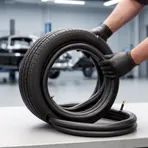
tubeless tire
- noun
- /ˈtuːbləs taɪər/
- Specialized
- By using tubeless tires, the car can maintain better performance and fuel efficiency due to lower rolling resistance.
Examples
-
The new car model is equipped with tubeless tires for improved safety and convenience.
-
I bought a new tubeless tire for my bike.
-
Many cyclists prefer tubeless tires because they are less prone to punctures.
-
Switching to tubeless tires can also lead to a smoother ride on rough terrain.
-
Many cyclists prefer tubeless tires for better performance.
-
The new mountain bikes are equipped with tubeless tires that improve handling and reduce weight.
-
Many cyclists prefer tubeless tires for their advantages in puncture resistance and better ride quality.
Antonyms


Surface Forms
Morphology
The noun is directly and compositionally built from 'tubeless' (without an inner tube) + 'tire' (wheel rubber), so the overall meaning 'a tire that does not require an inner tube' is immediately derivable. This is a transparent compound following regular English morphology and similar constructions exist in many languages, so a B1 learner who knows the constituents will understand it.
Etymology
Tubeless tire comes from the simple image of a tire that has 'no inner tube' inside it. The tire fits tightly to the wheel and keeps air by itself, so the name means a tire that holds air with 'no inner tube'.