
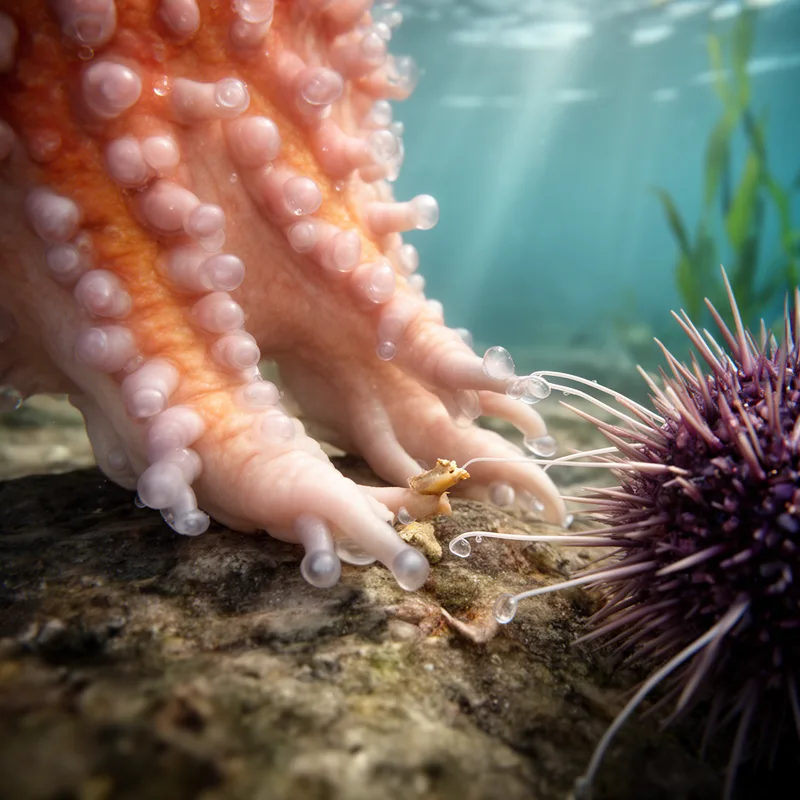
tube foot
 1
9.1
1
9.1

- noun
- /tjuːb fuːt/
- Specialized
- The animal's tube feet are also visible between the spines.
- sea star tube feet
Examples
-
Other tube feet are used just for sensing the environment.
Academic text (1992) -
One tube foot makes contact with the sea slug!
Academic text (2009) -
Their tube feet, which emerge through rows of holes in five areas of their hard outer shell, evolved for specific functions.
Academic text (1992) -
By secreting a sticky mucus, some tube feet pick up grains of sand and transport them to the urchin's mouth.
Academic text (1992) -
Enter a sunflower sea star, menacingly waving all twenty-four arms, studded with 15,000 sucker-tipped tube feet.
Academic text (2009) -
The starfish uses its tube feet to move along the ocean floor.
-
The sea urchin extends its tube feet to grasp onto rocks and gather food.
-
By contracting its muscles, the sea star can control its tube feet for efficient movement.
Synonyms
 188
8.6
188
8.6
A soft part animals like snails use to move or stick to things
A soft body part that animals without backbones use to move or hold on
Surface Forms
Morphology
The compound is directly compositional: 'tube' (a hollow cylinder) plus 'foot' (a locomotor/attachment organ) yields a tube-shaped foot or appendage, so a B1 learner who knows both words can infer it is a tubular organ used for movement or attachment. While detailed biological features (suckers, occurrence in echinoderms) are specialist knowledge, the core meaning is transparent and predictable from the constituents.
Etymology
Tube foot comes from a clear image: a small body part that looks like a soft tube with a tiny foot or suction cup at the tip. Imagine a starfish using many of these little tubes as feet to move, hold on to rocks, and take food—so the name fits its use for 'movement', 'feeding', and 'holding on'.