
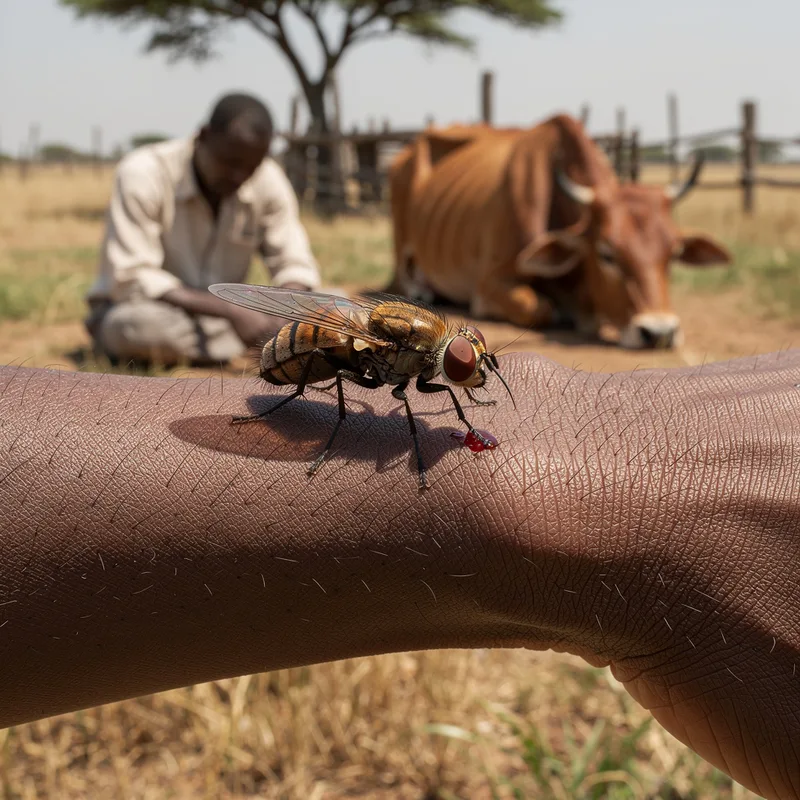
tsetse fly
 1
8.7
1
8.7

- noun
- /ˈtɛtsi flaɪ/
- South African
- In this regard, it has also been claimed that tsetse flies prevent cattle from entering game parks and thus preserve the parks for wildlife.
- species of tsetse fly
- tsetse fly control
Examples
-
Sebungwe was a large, remote, and tsetse fly-ridden district bordering the Zambezi in the northwest of Rhodesia.
Academic text (2005) -
Although the Department of Conservation made efforts to get rid of the tsetse fly menace through massive spraying campaigns, the fly was never completely eliminated.
Academic text (2005) -
The visual system of the tsetse fly is particularly sensitive to large blocks of contrasting color.
Academic text (2003) -
Tsetse fly eradication is a top priority in the Ethiopian government's efforts to promote agricultural self-sufficiency.
Academic text (1998) -
Along this stretch of road, we were bitten by Tsetse flies, especially around the ankles—an unpleasant experience.
Academic text (2003) -
More than 10 million square kilometers of land across Africa lie idle or underused because the presence of tsetse flies renders the areas either uninhabitable or unable to support healthy livestock.
Academic text (1998) -
With fewer elephants, trees and grasses would have grown back, creating the shade required by the tsetse fly, whose bite can transmit a parasite that can be fatal to cattle and humans.
Academic text (2005) -
In these thickets, tsetse flies would thrive—and tsetse flies are responsible for sleeping sickness, or human African trypanosomiasis.
Academic text (2013) -
The tsetse fly is known for transmitting sleeping sickness to both humans and animals.
-
Farmers in rural Africa often struggle with the presence of the tsetse fly, which can harm livestock.
Synonyms
 3
9.9
3
9.9
A large African fly that sucks blood and spreads sleeping sickness to people and animals

Flies that drink blood and spread sleeping sickness in Africa
Surface Forms
Morphology
This is a straightforward noun-noun compound: 'tsetse' (a bloodsucking, disease-transmitting insect) + 'fly' (a small two‑winged insect) yields a fly of the tsetse type. If a B1 learner knows both constituent meanings, the compound meaning is directly derivable as a specific kind of fly, so the expression is compositional and predictable.
Etymology
Tsetse fly gets its name from a local African word 'tsetse' that people used for the biting insect, and people feared it because its bite could make animals and people very ill or fall into a long sleep. That's why tsetse fly now means the large African bloodsucking fly that spreads 'sleeping sickness'.