

true sandalwood
- noun
- /truː ˈsændlˌwʊd/
- Australian
- The heartwood of true sandalwood is prized for its ability to repel insects naturally.
Examples
-
Many antique boxes from Southeast Asia are crafted from true sandalwood because of its pleasant aroma.
-
The true sandalwood tree grows primarily in Indonesia.
-
Due to overharvesting, true sandalwood has become increasingly rare in the wild.
-
Many artisans prefer using true sandalwood for their carvings.
-
Many antique boxes from true sandalwood are crafted from its fragrant heartwood, making them highly sought after.
-
The heartwood of true sandalwood is valued for its pleasant scent and effectiveness in repelling insects.
-
Due to overharvesting, true sandalwood has become a rare and precious resource in the market.
Synonyms
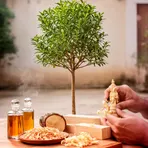
A small tree with very fragrant wood used for perfume and carving

A tree from Indonesia and Malaysia with sweet-smelling inner wood used to make perfume, oil, and furniture
Surface Forms
Morphology
The noun phrase is directly compositional: 'true' (genuine) modifies 'sandalwood' (the fragrant wood/tree), so a learner who knows both words can infer this refers to the genuine/specific sandalwood tree. The 'true + noun' pattern is common cross-linguistically and follows ordinary adjectival modification, making the meaning transparent to a B1 learner.
Etymology
True sandalwood was a name used by traders and craftspeople to show the 'real' aromatic wood — the yellow heartwood that gives a strong scent and naturally keeps insects away. So the phrase came to mean the genuine, valuable sandalwood tree used for chests and other objects.

