
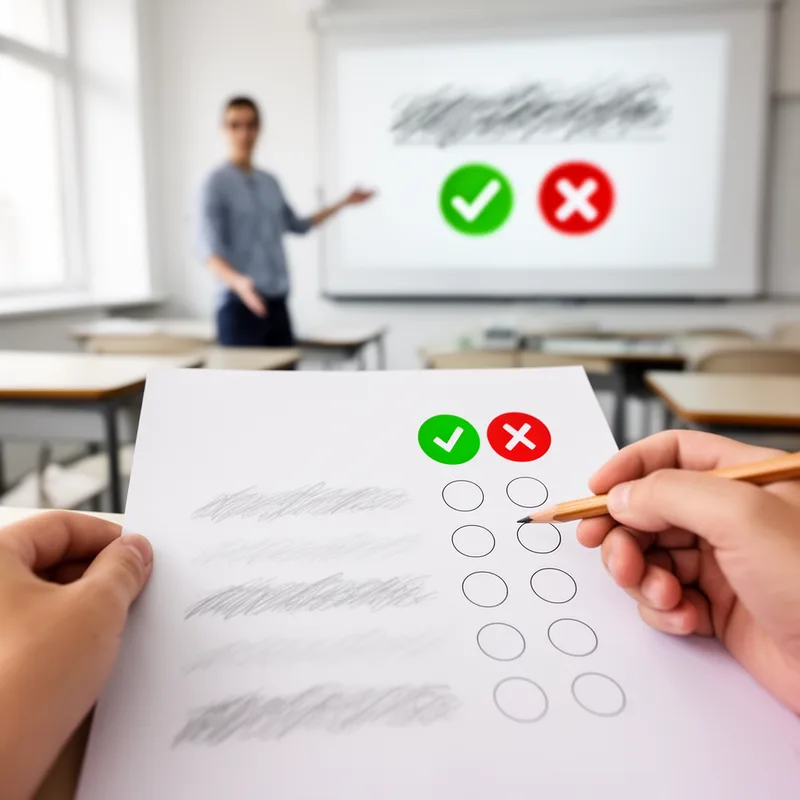
true-false
 1
2.8
1
2.8

- adjective
- /truː-fɔːls/
- For example, it is logical to think of a true-false test as simply a multiple-choice test with only two choices.
- true-false items
- true-false format
- true-false questions
Examples
-
The five knowledge items that tested understanding of the information contained in the educational materials were true-false questions.
Academic text (1995) -
The EPI is a 57-item, true-false format inventory to measure extraversion and neuroticism (Eysenck & Eysenck, 1964).
Academic text (1990) -
The normal mode of testing is true-false or multiple choice.
Academic text (1991) -
The full scale contains 90 true-false items, 10 for each subscale.
Academic text (2009) -
Test items written by the teacher to cover what was taught might consist of true-false or multiple-choice items.
Academic text (2003) -
There were 10 true-false and 10 multiple-choice questions based on course objectives.
Academic text (1993) -
The order of the tests for all groups was short answer recall questions first, true-false questions second, and multiple-choice questions third.
Academic text (1993) -
Other test formats (such as true-false, essay, and short answer) are even easier to fit into a database.
Academic text (1993) -
Another limitation of this study concerns the use of tests containing only multiple-choice and true-false items.
Academic text (1993) -
The exam included a section with true-false questions to assess basic knowledge.
Surface Forms
Morphology
Etymology
True-false is made from the two words true 'correct' and false 'not correct'. It means a question or test that asks you to choose only 'true' or 'false'.