
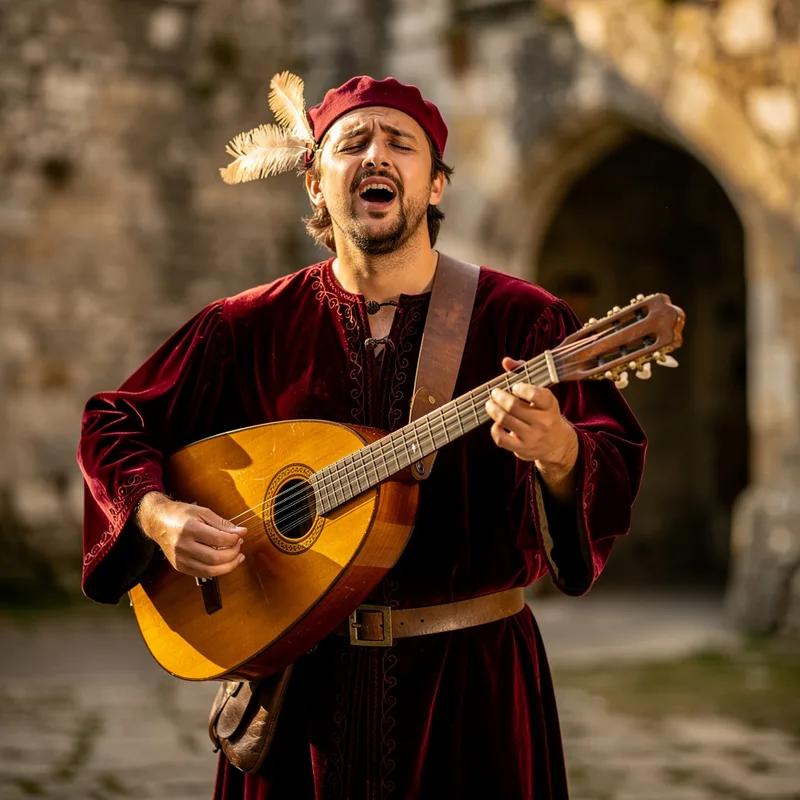
troubadour
 13
9.6
13
9.6

- noun
- /ˈtruːbəˌdʊr/
- Literature
- In medieval France, a troubadour would often perform in the courts, enchanting nobles with his melodies.
- the troubadour tradition
Examples
-
Here, Lara became acquainted with journalists, poets, and musicians, such as the romantic troubadours of Yucatan, who were migrating to the capital at the time.
Academic text (1996) -
Romance calls for "the far-away love" of the troubadours; marriage, for love of "one's neighbor."
Blog text (26) -
Sire Hunter's sister left this last night... in the house of the troubadour.
-
By romance, I mean the tradition of fiction that began in the Middle Ages, when the troubadours sang songs of love and adventure.
Academic text (1998) -
By tradition, the troubadours of Yucatan musicalized the poems of nineteenth-century romantic poets or composed songs within the same tradition.
Academic text (1996) -
The peaceful silence was broken by the voices and banjos of a group of troubadours—joyful sounds rising from the towers below us.
Academic text (2001) -
The troubadour captivated the audience with his songs of love and adventure.
-
As a famous troubadour, she traveled from town to town, sharing stories through her beautiful songs.
Synonyms
 6
9.6
6
9.6
A traveling singer who told stories and played music in medieval times
 1
9.9
1
9.9
A traveling singer in old England who sings songs and tells stories

A person who writes and sings folk songs that tell stories

A traveling entertainer from the Middle Ages who sang and did tricks
How Narrative
- Literature
30
9.8

- Literature
13
9.6
3
8.2
7
3.0
787
1.0
Surface Forms
Etymology
Troubadour comes from the language of southern France and the old verb trobar, which means 'to compose' or 'to find words'. So a troubadour was someone who 'found' and sang new poems about love and life, which is why the word means a poet-singer.