
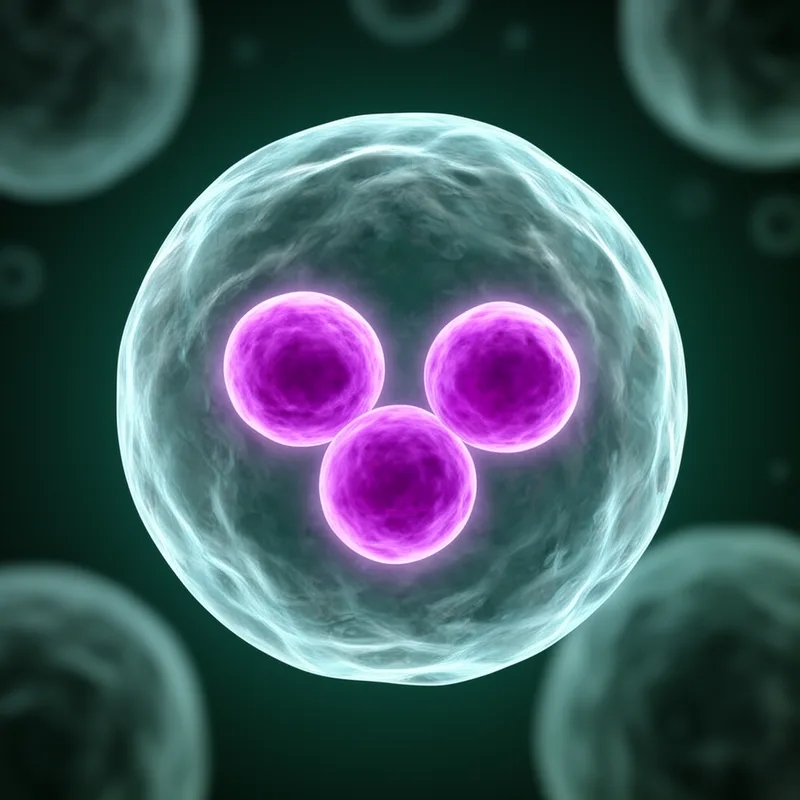
trinucleate
- adjective
- /ˌtraɪˈnjuːkliˌeɪt/
- Specialized
- The trinucleate cells were observed under the microscope.
Examples
-
The trinucleate condition was confirmed through microscopic analysis of the tissue samples.
-
In the lab, we studied trinucleate organisms for our project.
-
Certain protozoan species have trinucleate stages during their life cycle.
-
Some fungal spores are trinucleate before undergoing further division.
-
Certain protozoan species have trinucleate stages during their life cycle.
-
Some fungal spores are trinucleate before undergoing further division.
-
The trinucleate condition was confirmed through microscopic analysis of the tissue samples.
Synonyms

A cell that has three nuclei

A cell or molecule that has three nuclei
Antonyms

Surface Forms
Morphology
trinucleate = nucleate (transparent) = tri + nucle + ate
Clearly formed by the productive prefix 'tri-' (three) added to the adjectival base 'nucleate' meaning 'having a nucleus'; the meaning 'having three nuclei' follows directly.
Etymology
The word trinucleate breaks into tri- 'three' and nucleus 'central part'. So a trinucleate cell is one that has 'three nuclei', which is why the word means 'having three central parts'.

