
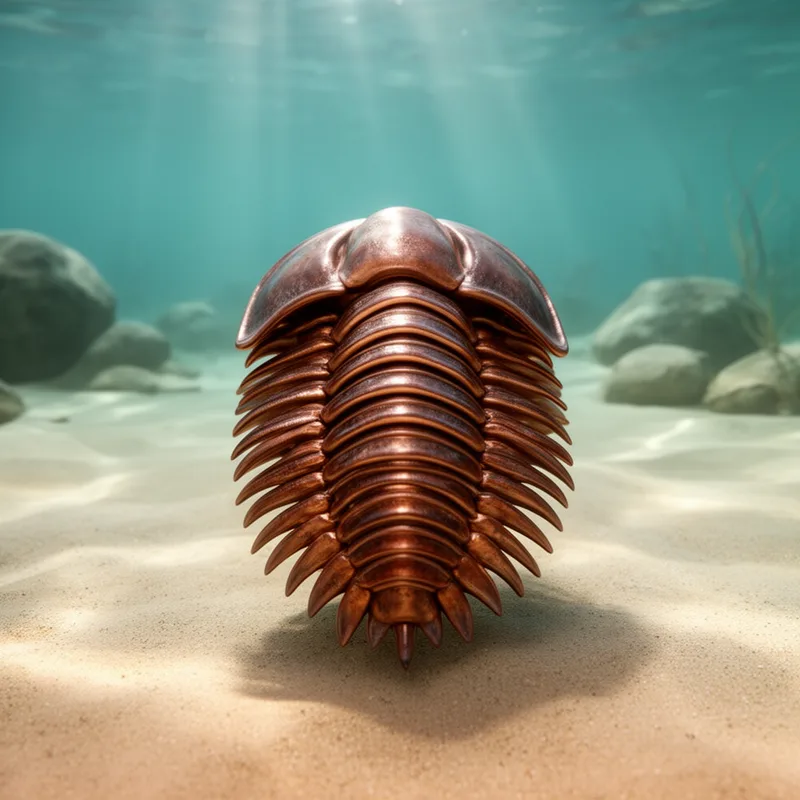
trilobite
 3
9.9

- noun
- /ˈtraɪləˌbaɪt/
- Specialized
- Beecher's Trilobite Bed has yielded numerous baby trilobites that exemplify both of these life histories.
- trilobite bed
- larval trilobites
- family of trilobites
Examples
-
These lenses allowed trilobites to form sharp images and quickly sense changes in light.
-
Fossils of soft body parts, like those found in Beecher's Trilobite Bed, are not simply preservational curiosities.
Academic text (1992) -
Life history, however, is not the only factor that influenced trilobite survival.
Academic text (1992) -
Scientists, of course, do this too when they explain the delicate structure of a trilobite or the chemical reactions driving a star.
Academic text (2016) -
We joined the researchers at Beecher's Trilobite Bed in August 1989.
Academic text (1992) -
Levels of oxygen available in the trilobite's last haunts may have been crucial.
Academic text (1992) -
Even after the extinction of Triarthrus, other kinds of trilobites lived on.
Academic text (1992) -
A sudden, massive influx of fine mud entombed the trilobites and the rest of the aquatic community.
Academic text (1992) -
In 1892, after repeated attempts, he located the level of the outcrop from which the trilobites had been dislodged.
Academic text (1992) -
In the northern hemisphere, the trilobite fossil record is very rich.
Synonyms
A fossil of a small extinct sea animal with a hard shell and many body sections
An ancient sea animal with a hard shell known from fossils found in southern South America
Surface Forms
Morphology
trilobite = lob (opaque) = tri + lob + ite
The term 'trilobite' is derived from its three-lobed form, but this specific meaning is not transparent to learners without specialized knowledge.
Etymology
Trilobite comes from parts meaning 'three' and 'lobe'; tri- is the same 'three' in triangle, and lobe is like an ear lobe. So a trilobite is a fossil animal whose body is split into three 'lobes', which is why its name fits its three-part shape.