
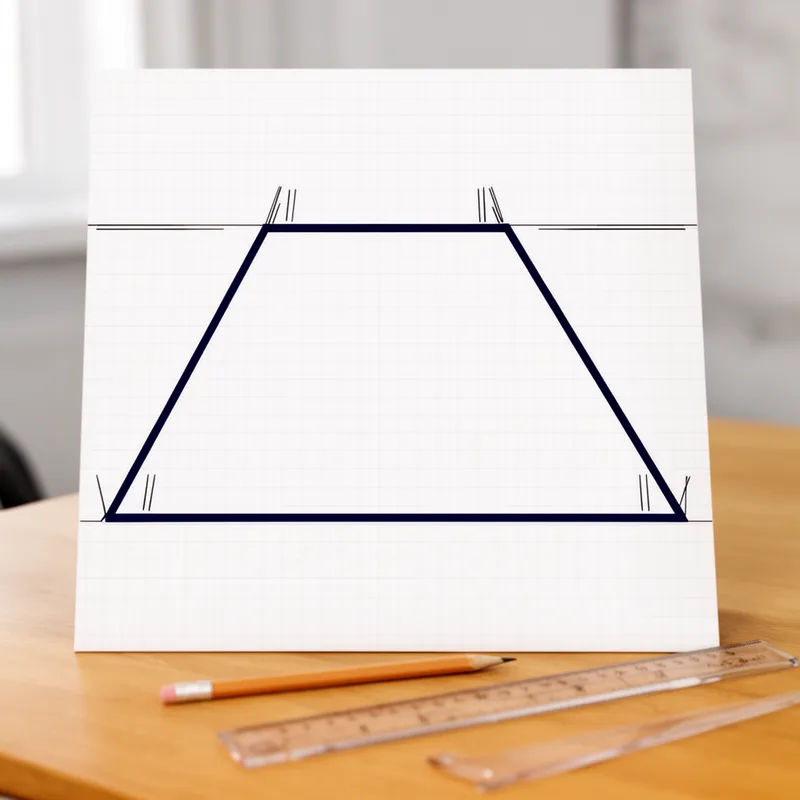
trapezoid
 2
5.6
2
5.6

- noun
- /ˈtræpəˌzɔɪd/
- Specialized
- The drawing showed a trapezoid with one pair of sides that were parallel, clearly illustrating its defining feature.
- a red trapezoid
- rectangles and trapezoids
Loading YouTube…
Watch on YouTubeAnd now we know each of these trapezoids must remain planar also.
- And now we know each of these trapezoids must remain planar also.
Examples
-
For example, the instructor asked students to make a trapezoid with an area of six square units using six pegs on the Geoboard.
Academic text (2009) -
From a plane, it probably looked like a trapezoid.
Fiction book (1993) -
But the trapezoid has four sides!
-
We're trying to find some friends who wanted a bag in the shape of a trapezoid.
-
But the shape we're going for right now is a trapezoid that is longer in the front and narrower in the back.
-
This aisle has bags shaped like circles, but no trapezoids.
-
The broad-shouldered dolls are about six inches tall and shaped like a trapezoid with a head on top.
Academic text (2004) -
A green triangle, a blue rhombus, a red trapezoid, and a yellow hexagon represent each respective value as shown below.
Academic text (1996) -
This figure is a trapezoid and a rectangle of size n/2 by n/2.
Academic text (2000) -
Alternate subdivisions may include squares, trapezoids, and other polygons.
Academic text (2001)
Compounds

Surface Forms
Morphology
trapezoid = trapez + oid
Built from the Greek combining form 'trapez-' + the suffix '-oid' ('resembling'); the combining form is not a standalone English word, so the structure is partially clear but not fully transparent to average learners.
Etymology
Trapezoid comes from the Greek word trapezion, which means 'little table'. Think of a small four-legged table to picture a four-sided figure with one pair of parallel sides, and that image helps explain the shape we call a trapezoid.